BreakingTechnology
Green Card Debate: India Has Potential to Turn the Table
The Freeze has opened a new avenue for the domestic IT industry
10 Oct 2026, 08:07 am IST·4 min read

United States president Donald Trump’s proclamation to suspend Microsoft, Adobe and a host of other major IT outsourcers from the Green Card programme has triggered a very significant question.
Whether the latest US measure announced on October 8 (Thrusday) would be a setback for India or an unexpected opportunity for the country to turn the table against the American administration?
The answer may apparently depend on which category of Green Cards is affected, how long the suspension lasts, and whether Indian professionals redirected by the restrictions can find comparable opportunities at home or elsewhere.
Nevertheless, the moot point remains Trump wants fewer Indian technology professionals moving to America. The unintended consequence may be more American technology work moving to India.
For Indian professionals, a Green Card, it is true, represents more than a permission to reside permanently in America. It offers the prospect of long-term career stability, family security and greater freedom from dependence on temporary immigration status.
The suspension could prolong uncertainty for employees awaiting employer-sponsored permanent residency.
Secondly, the consequences extend beyond individual careers. Indian IT companies derive substantial business from the American market. Greater regulatory uncertainty could complicate recruitment, employee retention and workforce planning, potentially increasing compliance costs and affecting profitability.
New Delhi has already expressed concern. According to the Ministry of External Affairs (MEA), the American measures would hardly advance the two countries' shared ambitions, while emphasising that talent mobility produces tremendous mutual benefits.
Thirdly, IT stocks are the worst performers in India this year, slumping 25%, compared with a 14% drop in the benchmark. The firms, it is common knowledge, rely on the US market for a bulk of their revenue.
Then how could India turn the table against Mr Trump?
The corollary answer is simple but little tweaking is required to place the same.
A Windfall for India?
The Green Card freeze for India, is neither an unqualified disaster nor a windfall. On the contrary, it has opened an uncharted avenue for the domestic IT industry.
The US curbs have targeted Microsoft, Cognizant, Infosys, Tata Consultancy Services, Wipro and Capgemini.
Strange but true, India's IT index rose about 3%, led by TCS, which gained after a more-than-better second-quarter results. Both IT index and TCS logged their biggest percentage rise in six weeks on Friday.
The original Indian IT model was simple. The customer had important work in America, so Indian engineers travelled there to do it. Then we discovered that much of that work could be done from India. The onsite-offshore model was born.
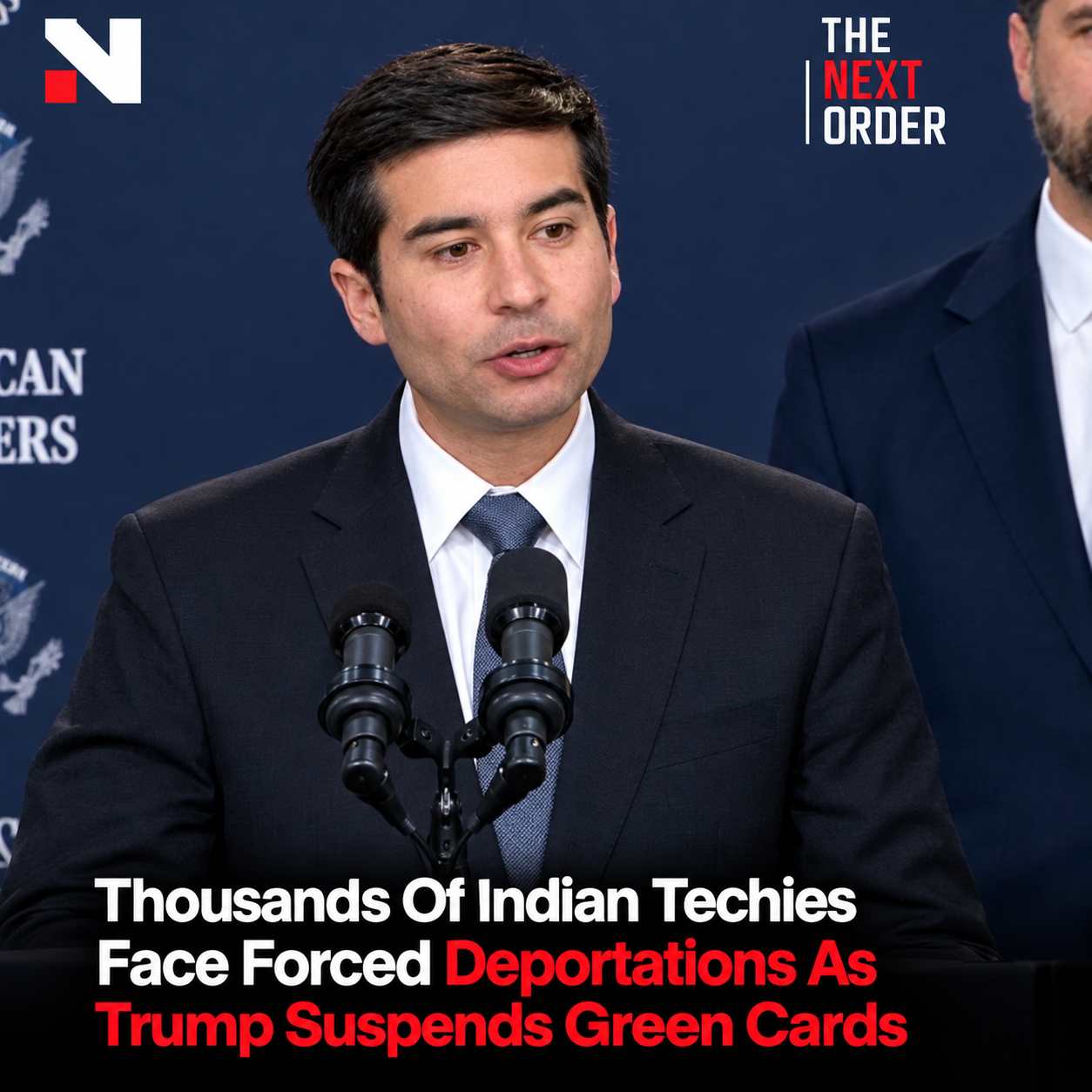
But a new model is about to be born and Mr. Trump might not be able to torpedo it.
America is making it harder to move Indian talent there, while technology is making it easier for smaller teams in India to take responsibility for increasingly sophisticated work.
Interestingly, there is a layered irony here. In trying to reduce the movement of Indian talent to America, the US may accelerate the movement of American work to India.
Let’s not confuse it with another wave of coding and maintenance jobs.
The opportunity is architecture, product engineering, cybersecurity, AI implementation, industry solutions and eventually ownership of products and IP.
The US IT giants themselves, hungry for talented and skilled workers, could increasingly cross the American shores to pitch their tents in India, aware as they are about the potential of the India IT pool which they can hire at a considerably lower cost than their US counterparts.
Indian teams should not merely receive specifications from New York. They should help decide what gets built. Not merely maintain a global bank’s technology platform, but help redesign the bank; not just supply engineers to solve somebody else’s problem, but own the problem.
There is an uncomfortable truth too we need to face.
For thirty years, growth in Indian IT and growth in Indian IT employment travelled together. Win more business, hire more engineers.
As AI technology improves productivity, that relationship may weaken. Indian IT could win more sophisticated work and create more value without headcount growing at the same rate.
So, we ought to carve a different definition of success.
For thirty years, Indian IT competed largely on the cost of Indian talent. The next thirty will depend on the capability of Indian talent.
Can we create architects rather than only programmers? Build products and IP here? Move more global decision-making to India? Create more value per person and therefore pay our people far better?
For India, the challenge is immediate; it would benefit only if its own research opportunities, remuneration, infrastructure and entrepreneurial environment prove sufficiently attractive.
About the Author

Prasanta Paul served Deccan Herald as the Chief of Bureau, Calcutta for nearly two decades before switching to work with various TV channels such as Al-Jazeera, CNN, German TV and CBS. He also headed the Eastern Bureau of Parliamentarian magazine. Mr. Paul who accompanied former Prime Minister Atal Behari Vajpayee on his overseas tour of Singapore and other Asian countries, travelled extensively to Bhutan, Sikkim and Darjeeling besides other Northeastern states. He briefly headed the Mizoram Bureau of the United News of India (UNI).
Discussion
Reader Comments
No comments yet. Be the first to share your perspective.