BreakingNational
The Great Bengali Food Debate: Veg or Non-Veg?
Food choice, cultural plurality & who gets to prescribe faith
11 Sep 2026, 11:09 am IST·3 min read
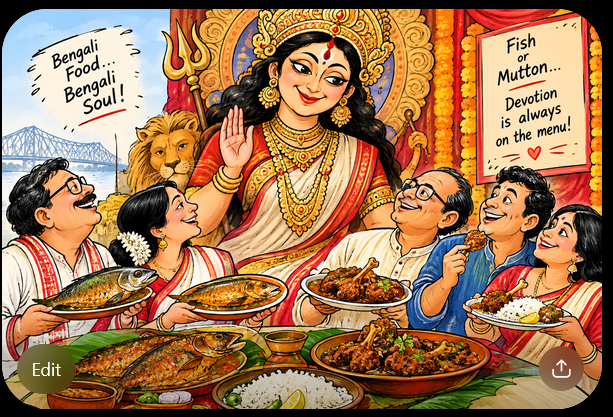
To eat or not to eat — that is the question.
No, please pardon the Shakespearean intrusion. Hamlet has nothing to do with this particular tragedy. This is about something far more serious in Bengal: what a Bengali is supposed to put on his plate when Ma Durga comes home.
After waiting twelve long months for Uma to descend from the Himalayas for her annual four-day family reunion, Bengalis now have another anxious question to settle: will somebody please allow them to decide what they may eat?
The controversy erupted after self-styled godman Dhirendra Krishna Shastri, popularly known as Bageshwar Baba, appealed to Hindus in Bengal to keep non-vegetarian food away from Durga Puja venues during Navratri.
Speaking at an event in Liluah on September 6, he questioned the practice of eating non-vegetarian food during the festival and urged devotees not to sell or consume it near idols.
His remarks triggered a swift backlash.
And suddenly, Bengal found itself confronting a question that may be more complicated than the Mahishasura problem: who exactly gets to decide what a Bengali should eat?
Fortunately for anxious fish-loving and mutton-loving devotees, the state BJP leadership moved quickly to reassure the faithful.
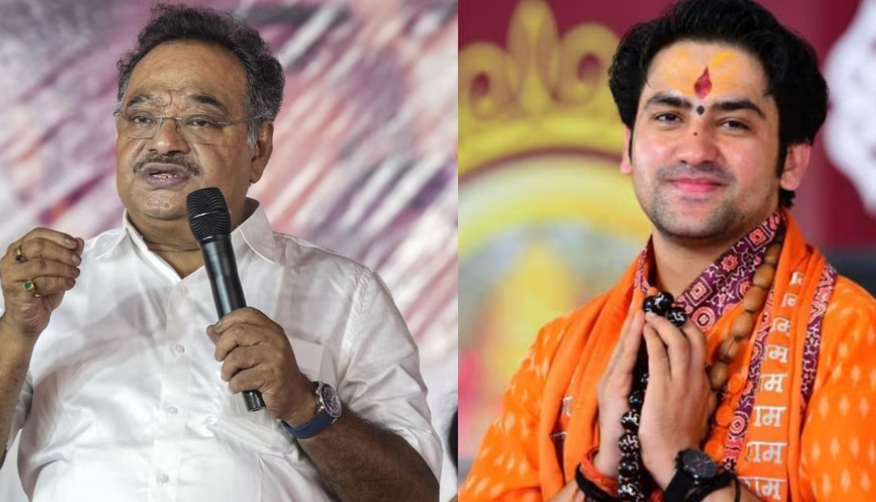
West Bengal BJP president Samik Bhattacharya made it clear that nobody from outside the state could prescribe Bengal's dietary habits. “No Baba is bigger than Swami Vivekananda,” he said, arguing that Bengalis have their own food traditions and would continue to eat what they traditionally eat.
He pointed out that non-vegetarian food has long been part of Bengal's cultural landscape and invoked the tradition of offering mutton to Goddess Kali.
There was, therefore, something almost reassuringly Bengali about the political damage control: Ma Durga may be divine, but the fish market remains stubbornly secular.
Bengali’s Knack for Gastronomy
Indeed, Bengal has never maintained a single, laminated rulebook for food and faith. There are households where Puja means strict vegetarian fare; there are others where fish and meat remain integral to the festivities. Shakta traditions themselves have accommodated varied forms of worship and offerings.
For Bengalis, food is not merely nutrition. It is memory, family, season, neighbourhood, argument and, occasionally, a matter of constitutional importance — at least at the dining table.
Which is why the question is larger than fish versus vegetables. It is about whether faith can be measured by the contents of one's plate.
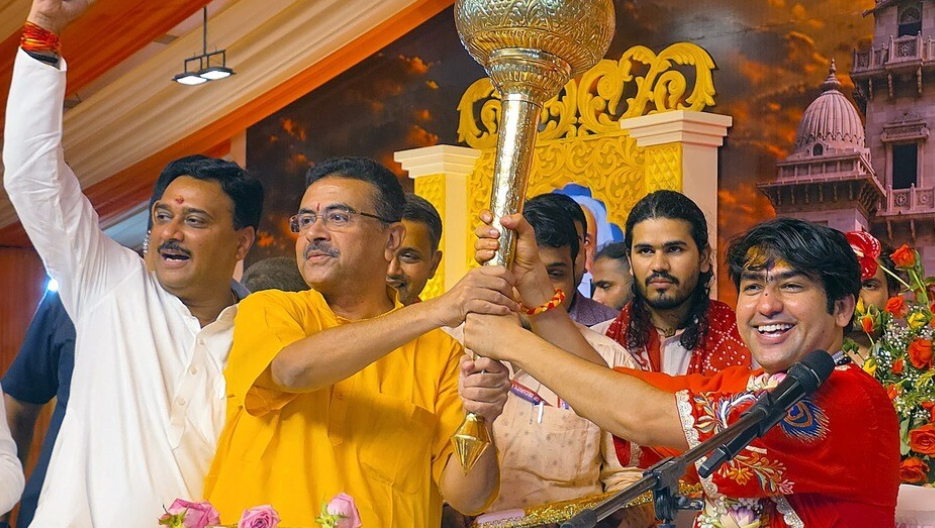
Chief Minister Suvendu Adhikari, speaking in the Assembly, sought to separate personal belief from public prescription. A religious leader was entitled to express his own opinion, he said, but whether people would accept it was entirely their choice.
He also objected to the subsequent burning of the godman's photographs.
The irony, meanwhile, has been difficult to miss.
Now the controversy over Bengali food has acquired a political life of its own.
Thus, just before the drums begin and the dhak starts announcing the arrival of the Goddess, Bengal finds itself conducting an unusually earnest investigation into the contents of its Puja plate.
The answer, however, may be simpler than the politicians, preachers and pundits would like it to be.
Some Bengalis will eat vegetarian food. Some will eat fish. Some will eat mutton. Some will eat all three, possibly with dessert.
And Ma Durga, one suspects, will survive the confusion rather comfortably.
After all, she has been defeating demons for centuries.
Surely, she can handle a Bengali lunch.
About the Author
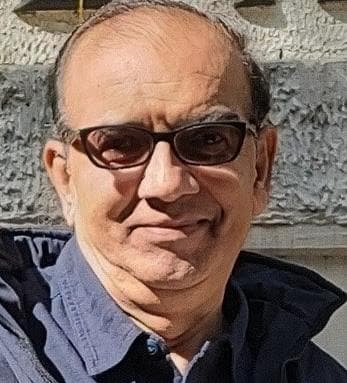
Prasanta Paul served Deccan Herald as the Chief of Bureau, Calcutta for nearly two decades before switching to work with various TV channels such as Al-Jazeera, CNN, German TV and CBS. He also headed the Eastern Bureau of Parliamentarian magazine. Mr. Paul who accompanied former Prime Minister Atal Behari Vajpayee on his overseas tour of Singapore and other Asian countries, travelled extensively to Bhutan, Sikkim and Darjeeling besides other Northeastern states. He briefly headed the Mizoram Bureau of the United News of India (UNI).
Discussion
Reader Comments
No comments yet. Be the first to share your perspective.
Similar Stories

National
Junput’s New Defence Frontier: India Turns to the Invisible Battlefield
US-Iran War: the shift from visible kinetic warfare to the invisible battle for electromagnetic superiority is likely to provide India with a unique capability.
Prasanta Paul·12 Sep 2026
National
In the Mangroves, the Sunderbans Took Ajit
The extraordinary decision of a remote Sunderbans family to turn personal bereavement into a chance of life for others; illiteracy or superstition no bar.
Prasanta Paul·10 Sep 2026
National
Opening of Space & Nuclear Segments: Who Protects the Knowledge Vault?
Private Space & Nuclear Sector Push Raises a Big Question: Who will guard India’s strategic sectors and ensure adherence to IPR?
Prasanta Paul·08 Sep 2026
