BreakingScience and Space
3.5-billion-Year-Old Rock Rewrites Lunar History
The discovery offers rare evidence of impact flux of the inner solar system
25 Jun 2026, 12:30 pm IST·3 min read
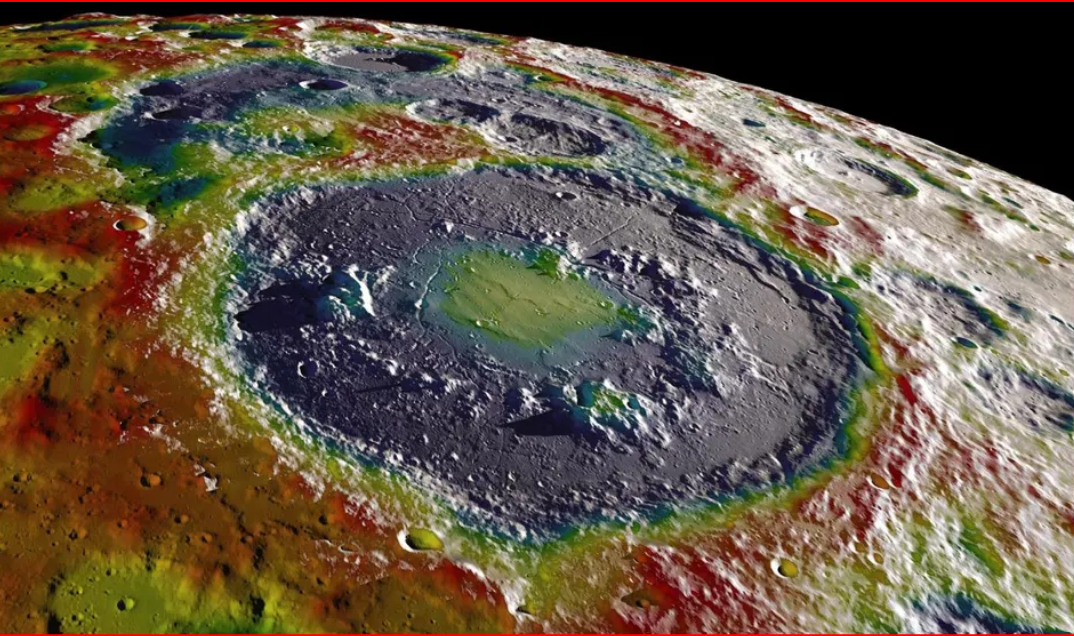
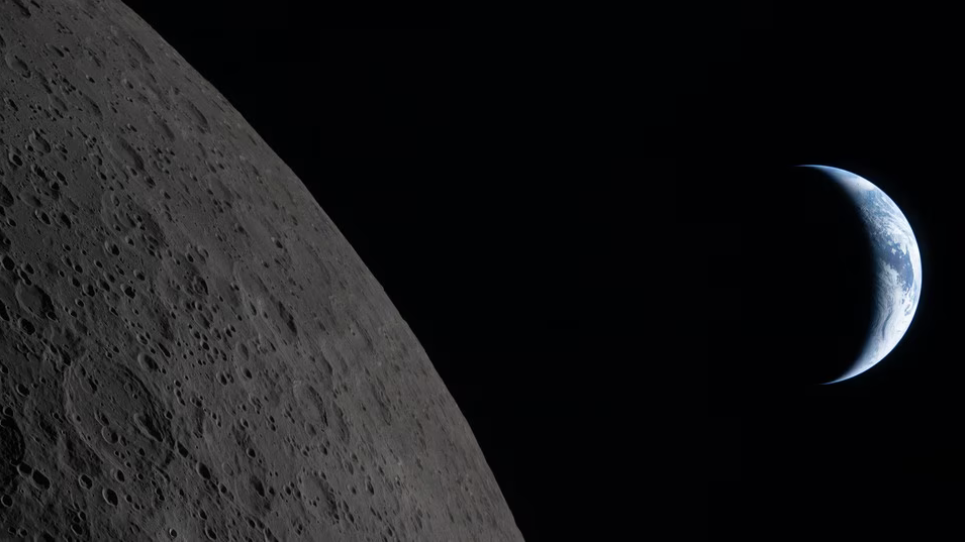
A rare lunar meteorite recovered from northwest Africa preserves geochemical evidence of a previously unrecognized impact event on the Moon, dated to approximately 3.5 billion years ago (Ga).
The findings, reported in the journal Geology, offer new constraints on the impact flux of the inner solar system during the early Archean — a period coinciding with the earliest documented fossil evidence of life on Earth.
The specimen, designated NWA 12593, is a 311-gram olivine-phyric basalt, representing one of only 31 officially classified lunar basaltic meteorites on Earth.
Petrographically, the rock is characterized by relatively coarse olivine phenocrysts set within a basaltic groundmass, and contains melted glassy pockets and veins consistent with impact-induced shock metamorphism on the lunar surface prior to ejection.
Lead (Pb) isotope geochronology constrains the crystallization age of the basalt to approximately 2.35 Ga, making NWA 12593 the youngest basaltic lunar meteorite yet identified.
Geochemical Composition
Its geochemical composition — moderate titanium content, elevated potassium concentrations, and an anomalously high uranium-to-lead (U/Pb) ratio — is distinct from samples returned by previous crewed and uncrewed lunar missions, and is interpreted to reflect derivation from a deep-seated lunar mantle source region.
These characteristics may provide insight into mechanisms sustaining prolonged internal heat production within the Moon.
"On Earth, the first fossil evidence of life shows up around 3.5 billion years ago, meaning that life is emerging and evolving before then, " Carolyn Crow, first author of the study and a planetary scientist at the University of Colorado Boulder, said in a statement.
"The question that we often have, even going back further, is what was the impact record when life was emerging? It is important for understanding how life is taking hold… The cadence of these catastrophic events is an important part of the equation."
The meteorite records evidence of three discrete impact events; the present study focused on the oldest. Radiometric dating, exploiting the known decay rates of radioactive isotopes within the sample, constrains this earliest impact to ca. 3.5 Ga, approximately one billion years after solar system formation.

Chemical Clues
"It's younger than the basalts collected by the Apollo, Luna and Chang'e 6 missions, but older than the much younger rocks brought back by China's Chang'e 5 mission. Its age and composition show that volcanic activity continued on the Moon throughout this timespan,” said Dr Joshua Snape, a Research Fellow at the University of Manchester, UK, while presenting his views during a conference.
The presence of cubic zirconia — a high-temperature polymorph of zirconia (ZrO₂) that forms only under extreme thermal conditions — within the meteorite matrix provides direct mineralogical evidence that the lunar surface underwent impact-induced melting during this event.
Although cubic zirconia is thermodynamically unstable under the cryogenic conditions of the lunar surface and has since recrystallized, its former presence is inferred from the identification of its recrystallization products.
The shock history of the specimen introduces uncertainty into the geochronological interpretation, and the reported impact age carries an uncertainty of plus/minus 80 million years.
The temporal coincidence between the identified impact event and the emergence of early life on Earth underscores the relevance of the lunar impact record to astrobiology.
Characterising the cadence of large-scale impact events during the Hadean (referring to the earliest geologic eon of Earth's history) and early Archean remains critical to understanding the environmental boundary conditions under which life first arose and subsequently evolved on Earth.
About the Author

Prasanta Paul served Deccan Herald as the Chief of Bureau, Calcutta for nearly two decades before switching to work with various TV channels such as Al-Jazeera, CNN, German TV and CBS. He also headed the Eastern Bureau of Parliamentarian magazine. Mr. Paul who accompanied former Prime Minister Atal Behari Vajpayee on his overseas tour of Singapore and other Asian countries, travelled extensively to Bhutan, Sikkim and Darjeeling besides other Northeastern states. He briefly headed the Mizoram Bureau of the United News of India (UNI).
Discussion
Reader Comments
No comments yet. Be the first to share your perspective.