BreakingInternational
EDITORIAL: Himalayas on the Edge: Catastrophe Rekindles Alarm Over Fragile Mountain Ecology
The roof of the world may soon cease to remain so.
28 Aug 2026, 11:10 am IST·4 min read
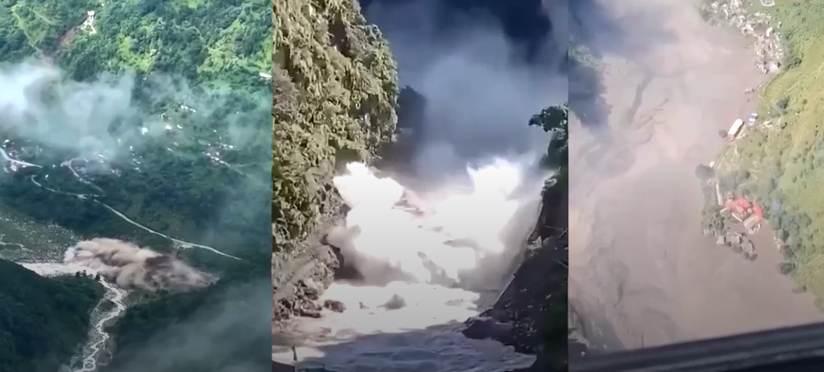
The catastrophic avalanche and flash floods that have swept across the Himalayan borderlands of Nepal and China’s Tibet, leaving hundreds dead and nearly 1,500 people missing, have once again exposed the terrifying fragility of the world’s highest mountain system.
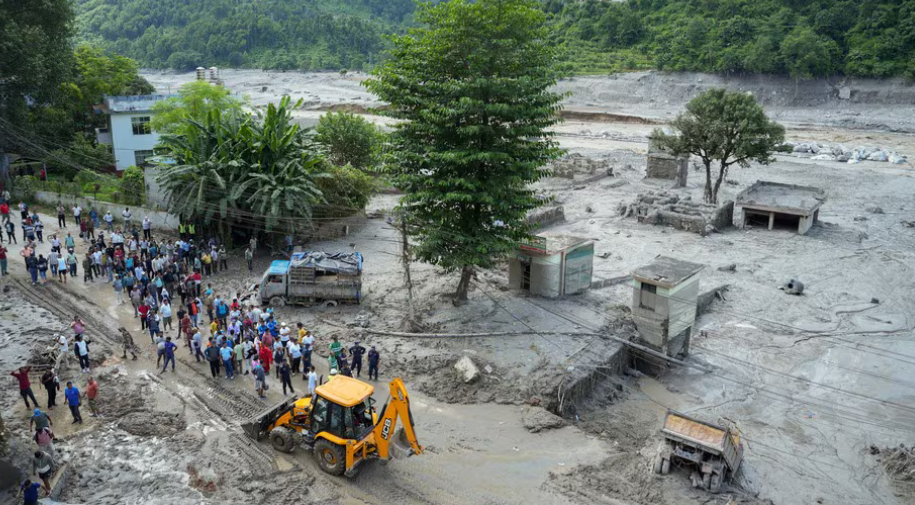
What began with the collapse of ice, mud and rock high in the Himalayas quickly turned into a monster of destruction. A massive debris flow surged through mountain valleys, swallowing settlements, roads and infrastructure and leaving rescuers searching through an apocalyptic landscape for survivors.
Hundreds of foreign tourists and pilgrims travelling through the region were among those reported missing as the tragedy unfolded on both sides of the Nepal-Tibet frontier. The disaster, whose human toll is still rising, has also triggered fears of further flooding from unstable river blockages and mountain lakes.
Apprehensions of authorities in Nepal and China have come to be true like the Doom’s Day as the rivers laden with mud and debris threaten to change their courses having encountered massive wall of obstruction at two places in the valley.
Plus, on the `roof’ of the world, glacial lakes, satellite pictures have revealed, are threatening to burst. China has washed its hands off against all accusations that Beijing ignored the urgency of alerting Kathmandu of the atrocious impending calamity.
Global Warming & Relentless Human Intervention?
But beyond the immediate tragedy lies a larger and increasingly disturbing question: how long can the Himalayas—and particularly the ecologically delicate Tibetan Plateau—absorb the combined assault of global warming and relentless human intervention?
The scientific warning is unmistakable. The Hindu Kush Himalaya and the Tibetan region have already experienced significant glacier retreat, snowmelt and permafrost degradation as temperatures have risen.
The Intergovernmental Panel on Climate Change (IPCC) has warned that glacier mass loss, warming permafrost and the expansion of glacial lakes are making mountain environments increasingly unstable. As glaciers retreat, new lakes can form beneath steep and unstable slopes, increasing the danger of devastating glacial lake outburst floods and cascading disasters far downstream.
The present catastrophe may therefore be seen as part of a broader Himalayan pattern in which warming temperatures are weakening nature’s frozen defences.
Ice that once held mountain slopes together is disappearing. Permafrost is thawing, reducing slope stability. Snow and glaciers are melting, while glacial lakes are growing in both number and size in vulnerable areas.
On the Tibetan Plateau, often called the “Third Pole” because of its vast reserves of ice and snow, these changes carry consequences far beyond China. The plateau is the major source region for some of Asia’s greatest river systems and its environmental health is intimately connected with the lives of hundreds of millions of people downstream.
China’s Unabated Construction Activities
It is against this backdrop that concerns over China’s unabated infrastructure and construction expansion across Tibet acquire a new urgency. Roads, railways, hydropower projects, urban growth, tunnels and other major works have transformed parts of the plateau at extraordinary speed.
Development by itself cannot automatically be blamed for glacier collapse or global warming. Indeed, no evidence has yet established that construction activity caused this week’s disaster.
Yet environmentalists have long warned that intensive development in a region of high altitude, fragile geology and rapidly thawing permafrost can compound existing vulnerabilities.
Large-scale alteration of land, excavation and construction may place additional stress on already unstable mountain ecosystems, while expanding human activity also means that more roads, settlements and infrastructure lie directly in the path of floods, landslides and avalanches.
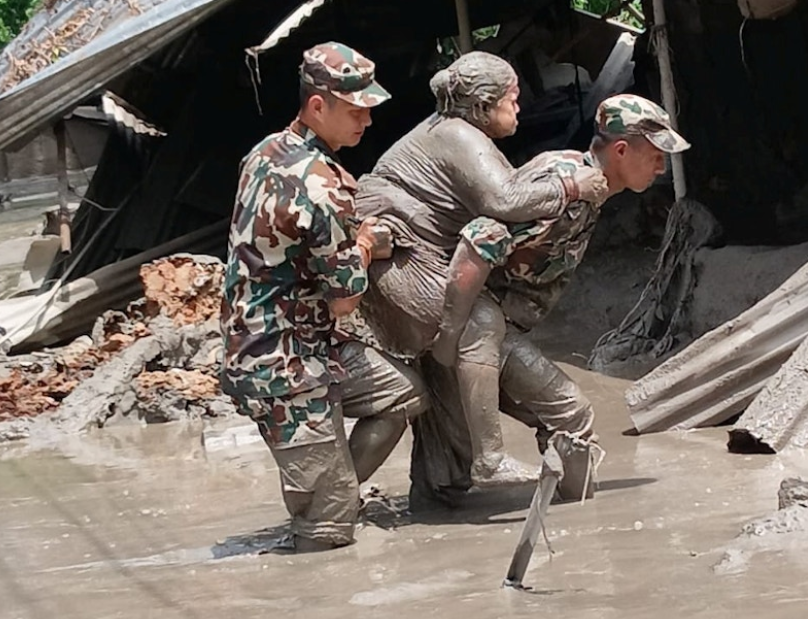
Rescuing the injured & the stranded elderly lady.
The Tibetan Plateau is itself warming and its permafrost is degrading at an accelerating pace, according to recent scientific research. Such degradation threatens not only ecosystems but also the stability of infrastructure built upon frozen ground.
A Deeper Lesson
That is the deeper lesson emerging from the Nepal-Tibet catastrophe. The Himalayas are not an inexhaustible frontier waiting to be conquered by concrete, steel and machines. They are a living, shifting and exceptionally sensitive ecological system—one now being shaken simultaneously by planetary warming and mounting developmental pressure.
The disaster should therefore become more than another grim entry in the growing catalogue of Himalayan tragedies. It should force governments across the region to reassess how development is planned in high-altitude zones, strengthen monitoring of glaciers and glacial lakes, and treat environmental risk assessments as matters of survival rather than bureaucratic formality.
For the nearly 1,500 people missing amid the mud, ice and broken valleys, such questions may come painfully late. But as the Himalayas continue to warm and their frozen foundations weaken, the warning from this catastrophe could not be clearer: what happens on the roof of the world will not remain on the roof of the world.
About the Author

Prasanta Paul served Deccan Herald as the Chief of Bureau, Calcutta for nearly two decades before switching to work with various TV channels such as Al-Jazeera, CNN, German TV and CBS. He also headed the Eastern Bureau of Parliamentarian magazine. Mr. Paul who accompanied former Prime Minister Atal Behari Vajpayee on his overseas tour of Singapore and other Asian countries, travelled extensively to Bhutan, Sikkim and Darjeeling besides other Northeastern states. He briefly headed the Mizoram Bureau of the United News of India (UNI).
Discussion
Reader Comments
No comments yet. Be the first to share your perspective.