BreakingNational
Fair Is Foul, Foul Is Fair
Central Drugs Control cautions against two Pak-made fairness creams
17 Sep 2026, 12:22 pm IST·2 min read
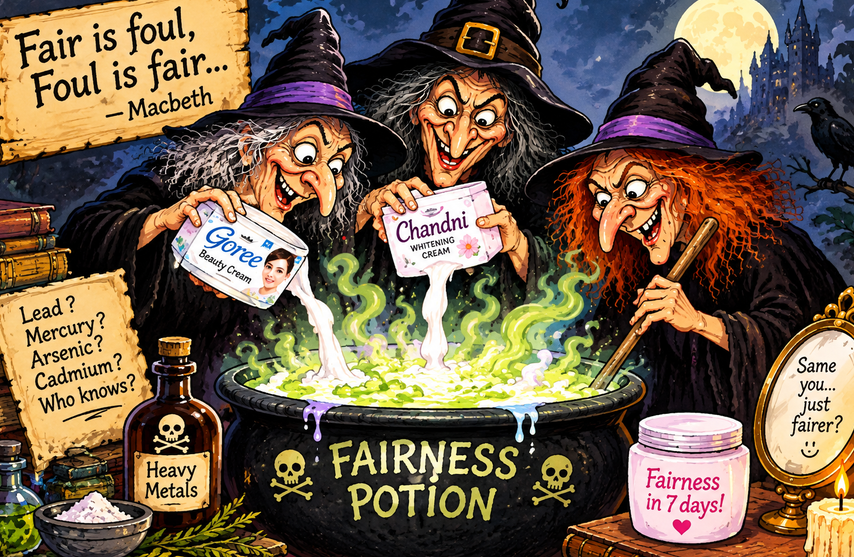
“Fair is foul, and foul is fair.”
When Shakespeare’s three witches opened Macbeth with those immortal words, the Elizabethan audience probably enjoyed the delicious contradiction. Four centuries later, however, the line has acquired an unexpectedly modern relevance—especially for those who have spent a lifetime trying desperately to make themselves “fair”.
For generations, fairness has been treated in this part of the world almost as a national aspiration. Marriage advertisements demanded it, matrimonial aunties inspected it and cosmetic advertisements promised to manufacture it, preferably within seven days and, if possible, before the next family wedding.
The cosmetic industry, naturally, was only too happy to oblige.
But now comes an official warning that gives the old Shakespearean pun a rather sinister aftertaste.
The Central Drugs Standard Control Organisation (CDSCO) has issued a public-health alert against two unauthorised cosmetic products—Goree Beauty Cream and Chandni Whitening Cream, both marked as made in Pakistan.
According to CDSCO, the products have not been registered for import into India and contain excessive levels of heavy metals beyond specified limits, posing health risks including toxic effects. The regulator has advised consumers not to buy or use them.
In other words, the quest for fairness may occasionally come with a most unfair price.
The irony is almost Shakespearean. A person buys a cream because he or she wants the skin to look brighter. The cream, meanwhile, may be carrying something considerably less bright—heavy metals.
One can almost imagine the dialogue:
“Why are you using this cream?”
“To become fair.”
“And what if it harms you?”
“At least I shall be fair.”
“Fair enough.”
Except that it may not be.
Representative picture
Larger Concern
The larger concern goes beyond these two products. CDSCO has reminded consumers that cosmetics sold in India are subject to regulatory requirements under the Drugs and Cosmetics Act, 1940, and the Cosmetics Rules, 2020.
Imported cosmetics must be registered with the competent central authority, while manufacturing cosmetics for sale requires the prescribed licensing. Standards are also laid down through the Bureau of Indian Standards (BSI).
Which means that the humble little jar sitting on the bathroom shelf is not entirely as innocent as it looks.
And there lies the real lesson.
The obsession with becoming fair has long been a social and commercial phenomenon. But skin is not a blank wall to be repainted every morning. Prolonged or indiscriminate use of an unauthorised cosmetic can expose a consumer to substances that were never meant to be there in excessive quantities.
The pursuit of complexion can therefore become a pursuit of complications.
So perhaps Shakespeare knew more about cosmetics than we imagined.
Fair may indeed be foul, and foul may indeed be fair.
The safest complexion, perhaps, is the one that comes with a properly labelled product, a legitimate manufacturer, a valid licence or registration, and no mysterious promises of becoming “fairer” by tomorrow morning.
After all, beauty may be skin deep.
But trouble can go considerably deeper.
About the Author
Prasanta Paul served Deccan Herald as the Chief of Bureau, Calcutta for nearly two decades before switching to work with various TV channels such as Al-Jazeera, CNN, German TV and CBS. He also headed the Eastern Bureau of Parliamentarian magazine. Mr. Paul who accompanied former Prime Minister Atal Behari Vajpayee on his overseas tour of Singapore and other Asian countries, travelled extensively to Bhutan, Sikkim and Darjeeling besides other Northeastern states. He briefly headed the Mizoram Bureau of the United News of India (UNI).
Discussion
Reader Comments
No comments yet. Be the first to share your perspective.
Similar Stories

National
Could the Bay of Bengal Hold a New Oil Bonanza for Bengal?
Future oil discoveries in the Bay of Bengal could be substantially larger than those currently being produced at Ashoknagar, Samik Bhattacharya.
Prasanta Paul·21 Sep 2026
National
Diamond May Soon Start Shining in Bengal, Samik Bhattacharya
“We’ve to reverse-engineer the earlier flight of capital from Bengal,” said Samik Bhattacharya “from diamonds to chips, capital has to return”.
Prasanta Paul·19 Sep 2026

National
Palace-on-Wheels: Bengal Explores Luxury Heritage Rail Circuit
The proposed luxury train could link major tourism and pilgrimage destinations across West Bengal, Bihar, Odisha and Assam among others.
Prasanta Paul·16 Sep 2026
