BreakingNational
‘Gerua’ Not for Debasement: Suvendu’s Firm Caution against Media, ‘Tukde Tukde Gang’
“An overwhelming national sentiment” emotionally & spiritually intertwined with the word
29 Aug 2026, 09:28 am IST·4 min read
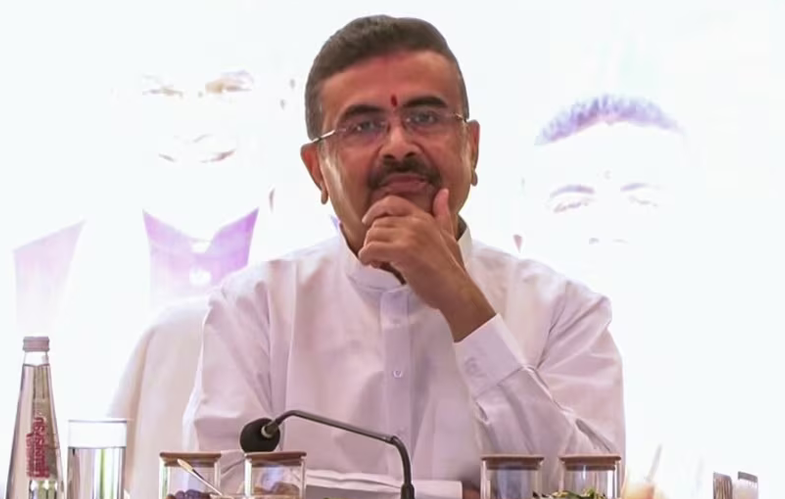
West Bengal Chief Minister and senior BJP leader Suvendu Adhikari on Friday launched a blistering attack on a particular media house for what he described as an act of utter disrespect towards the word Gerua—Saffron—accusing it of stooping to the level of associating a colour deeply embedded in India's religious and cultural consciousness with violence and, by implication, state-sponsored terror.
Though Adhikari stopped short of naming the media organisation, there was little ambiguity about the target of his fury. The BJP government, he declared, would not tolerate what he called the deliberate debasement and misrepresentation of Gerua, a colour with which, he said, “an overwhelming national sentiment” was emotionally and spiritually intertwined.
“Either you submit an unconditional apology or face the consequences,” the Chief Minister thundered.
The warning marked the culmination of an increasingly sharp offensive by Adhikari over the past several days, during which he had repeatedly objected to the use of the expression Gerua Tandav—or Saffron Fury—in connection with violent clashes at Jadavpur University between students belonging to a Naxalite faction and members of the ABVP, the Akhil Bharatiya Vidyarthi Parishad.
What particularly drew his ire was a headline that described the violence as Gerua Tandav.
“You could have called it Suvendu Bahini Tandav, BJP Tandav or Vidyarthi Parishad Tandav,” Adhikari said. “But not this. Never this expression.”
The distinction, for him, was far more than a quarrel over semantics.
Questioning whether those running the media house understood either the meaning or the sacred implications of the word Gerua, Adhikari said saffron symbolised sacrifice, renunciation and a centuries-old spiritual tradition.
“The tradition goes back to Sri Chaitanya Dev, Swami Vivekananda and hundreds of monks at Belur Math, to Swami Pranabananda and followers of ISKCON who continue to wear saffron dhoti, Punjabi and headgear,” he said.
“We can compromise on several other issues, but we cannot compromise on the misuse and misrepresentation of the word Gerua,” the Chief Minister declared amid loud applause.
“If my words are not taken seriously and no action is taken, a gathering of monks will lay siege at the right time and at the right place,” Adhikari warned.
Broadside at Tukde Tukde Gang
But his Friday broadside was not confined to the saffron controversy. Turning his guns on what he repeatedly described as the “Tukde Tukde Gang”, Adhikari linked the battle over political vocabulary to what he portrayed as a wider ideological struggle for the soul of institutions such as Jadavpur University.
After singing Vande Mataram, the Chief Minister questioned why slogans such as “Kashmir Maange Azadi” should be raised in Kolkata.
“Azadi? What kind of freedom do you want?” he asked in a sharply-worded attack. “Freedom to consume heroin? Freedom to smoke ganja? Freedom to take drugs? This is the Tukde Tukde Gang...”
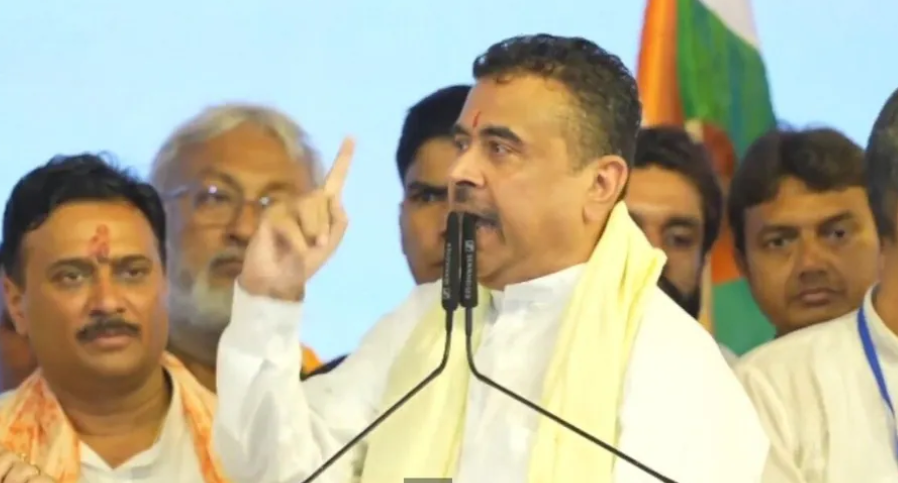
Adhikari then announced that the government would deploy drones to keep a watch over the Jadavpur University campus for surveillance at places where drugs, narcotics and other intoxicants were allegedly being consumed.
“Where ganja, drugs or heroin are being taken, where patta (leaves) are being burnt and smoked—we will find out,” he cautioned.
Urban Naxalite Graffiti
Referring to the slogan “Free, Free Palestine” painted on a wall, he said it should instead carry the message “Free POK”, calling for Pakistan-occupied Kashmir to be integrated with India.
He also questioned why the walls of Jadavpur University's Arts Faculty should carry graffiti such as “Kishenji Salute” and why slogans demanding freedom for Kashmir should be allowed.
Those raising or writing what he termed “anti-national” slogans, would face stern action. “That era will not continue,” he declared.
According to the Chief Minister, a “nationalist government” had now come to power in West Bengal and the “garbage” accumulated under the earlier political culture would be cleaned up.
At the same time, Adhikari sought to distinguish between the overwhelming majority of Jadavpur's students and the groups he was targeting. “90 per cent” of the university's students, he claimed, were nationalist and patriotic, but a smaller faction wearing Che Guevara T-shirts, intimidated others into joining their political campaigns.
For Adhikari, the fight is no longer merely over a provocative newspaper headline or graffiti on a university wall. It has become part of a larger political and ideological confrontation—over nationalism, the sanctity of symbols, the limits of protest and who gets to define the vocabulary of dissent in a politically transformed West Bengal.
And in that battle, he has made one thing abundantly clear: Gerua, in the new government's political lexicon, is not a word to be casually deployed, distorted or debased.
About the Author
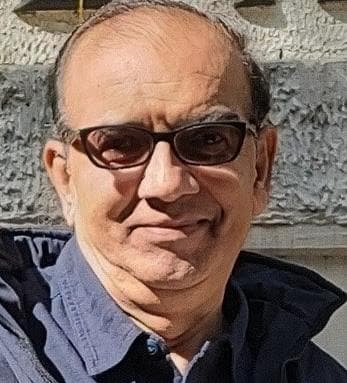
Prasanta Paul served Deccan Herald as the Chief of Bureau, Calcutta for nearly two decades before switching to work with various TV channels such as Al-Jazeera, CNN, German TV and CBS. He also headed the Eastern Bureau of Parliamentarian magazine. Mr. Paul who accompanied former Prime Minister Atal Behari Vajpayee on his overseas tour of Singapore and other Asian countries, travelled extensively to Bhutan, Sikkim and Darjeeling besides other Northeastern states. He briefly headed the Mizoram Bureau of the United News of India (UNI).
Discussion
Reader Comments
No comments yet. Be the first to share your perspective.