BreakingNational
Hatred Is Learnt. So Must Tolerance Be.
What we need today is another social renaissance
30 Jul 2026, 09:54 am IST·4 min read
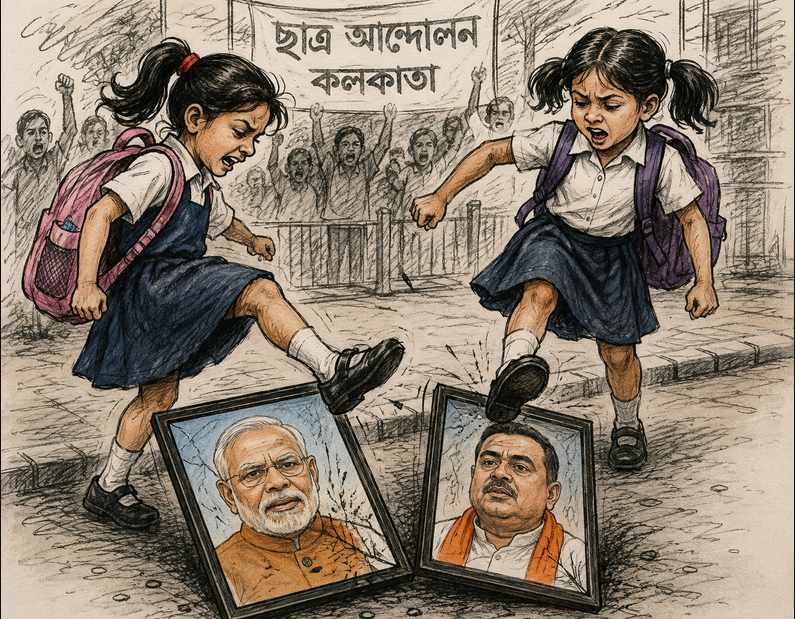
One highly talked about picture being widely circulated at the moment across the social media during the recent “students’ protest” has refused to leave my mind.
Two little schoolgirls, still in their uniforms with school bags slung across their shoulders, were seen kicking portraits of the Prime Minister Narendra Modi and the Chief Minister Suvendhu Adhikari to vent their anger.
They did it in full view of television cameras, almost as though they took pride in the act.
I cannot bring myself to blame those children.
If a child can internalize such intense hatred at such a tender age, then somewhere along the way, we—the adults—have failed.
It is also a painful reminder that our much-vaunted tradition of education and culture may not be as robust as we like to believe. Perhaps what we need today is nothing less than another social renaissance.
The years of childhood and adolescence are meant for writing poetry, humming songs without reason, running aimlessly through open spaces, or gazing dreamily at the sky through a classroom window.
If, instead, a child begins to nurture hatred and a desire for revenge, then the problem no longer belongs to a single family. It becomes a crisis of society itself.
The first casualty of every form of extremism is human conscience. Once that is lost, destruction follows almost naturally. And the minds of children remain its easiest targets.
Only the other day, while discussions were taking place over the possibility of writer Taslima Nasrin returning to Kolkata, former police officer Humayun Kabir publicly advised her on what she should—or should not—say or write.
His reasoning was candid: the Muslim community, he argued, has not yet evolved into a society capable of accepting such criticism with sufficient tolerance.
There is truth in that observation. Others may not agree though.
But an equally important question remains unanswered: has there ever been a sustained effort to cultivate that tolerance?
On one side, there are factories of radicalization, relentlessly manufacturing intolerance. On the other, political establishments—across parties and across states—often choose calculated silence, measuring every issue through the prism of electoral gain or loss.
Between these two forces, society itself has been pushed dangerously close to the edge of a cliff. One more shove may be enough to send it tumbling into the abyss.
Many believe that good education or professional success naturally insulates people from extremist thinking. Reality tells a different story.
The car bomb conspiracy uncovered near Delhi's Red Fort last year revealed the alleged involvement of a group of doctors from Kashmir. Investigators reportedly recovered substantial quantities of explosives and weapons from the accused.
The episode was a sobering reminder that academic achievement or social status alone does not inoculate anyone against the lure of radical ideology.
The problem lies much deeper.
That is why policing, arrests and punitive action, necessary as they are, cannot by themselves offer a lasting solution. Law enforcement must continue to enforce the law without compromise.
But alongside that effort, society must also invest in de-radicalization—bringing people back from the grip of extremist thought through engagement rather than fear alone.
Several countries in Europe and North America have experimented with such community-based interventions involving families, teachers, psychologists, social workers and religious leaders.
The Prevent programme in the UK seeks to identify vulnerable individuals through schools, healthcare institutions and local authorities before they drift toward violent extremism.
Germany's Hayat and EXIT Deutschland initiatives provide counselling and rehabilitation for those wishing to disengage from extremist networks. In the United States, the FBI has worked alongside community organizations under various Countering Violent Extremism (CVE) initiatives, encouraging families and civil society to become active partners in prevention.
These experiences underline one simple truth: hatred that has penetrated so deeply into the human mind cannot be defeated by force alone. It also demands reason, empathy, critical thinking and stronger social bonds.
Unfortunately, in India, public discourse on extremism is still largely confined to politics and criminal justice. We debate arrests, legislation and electoral consequences. Far less attention is paid to the psychological and social rehabilitation of those who are most vulnerable to radical influences—especially children.
That conversation can no longer wait.
We must consciously create an environment where young people are encouraged to ask questions rather than memorize dogma; where disagreement is not treated as betrayal; where they learn to listen to differing viewpoints; and where their primary identity is rooted in a shared sense of humanity before any political, religious or ideological label.
Watching the functioning of our present Chief Minister, one gets the impression that he is willing to break with convention and explore new approaches. If that is indeed the case, I would respectfully urge him to consider making West Bengal a pioneer in this field.
Let the police continue to perform their indispensable role. But alongside the legal process, let the state also launch voluntary, community-driven de-radicalization programmes that involve educators, families, mental health professionals and civil society.
If we ignore the seeds of hatred taking root in the minds of our children today, those very seeds will grow into far greater crises tomorrow.
Of that, there should be no doubt.
About the Author
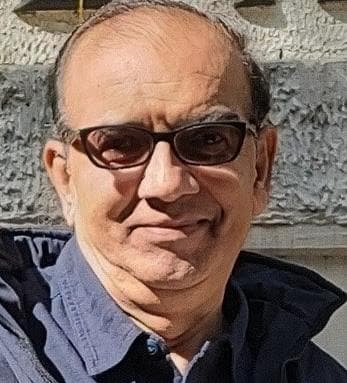
Prasanta Paul served Deccan Herald as the Chief of Bureau, Calcutta for nearly two decades before switching to work with various TV channels such as Al-Jazeera, CNN, German TV and CBS. He also headed the Eastern Bureau of Parliamentarian magazine. Mr. Paul who accompanied former Prime Minister Atal Behari Vajpayee on his overseas tour of Singapore and other Asian countries, travelled extensively to Bhutan, Sikkim and Darjeeling besides other Northeastern states. He briefly headed the Mizoram Bureau of the United News of India (UNI).
Discussion
Reader Comments
No comments yet. Be the first to share your perspective.