BreakingNational
India Building a Security Shield Around the Chicken’s Neck
Aim: Dovetail territorial security architecture with strategic military mobility
01 Sep 2026, 10:51 am IST·3 min read
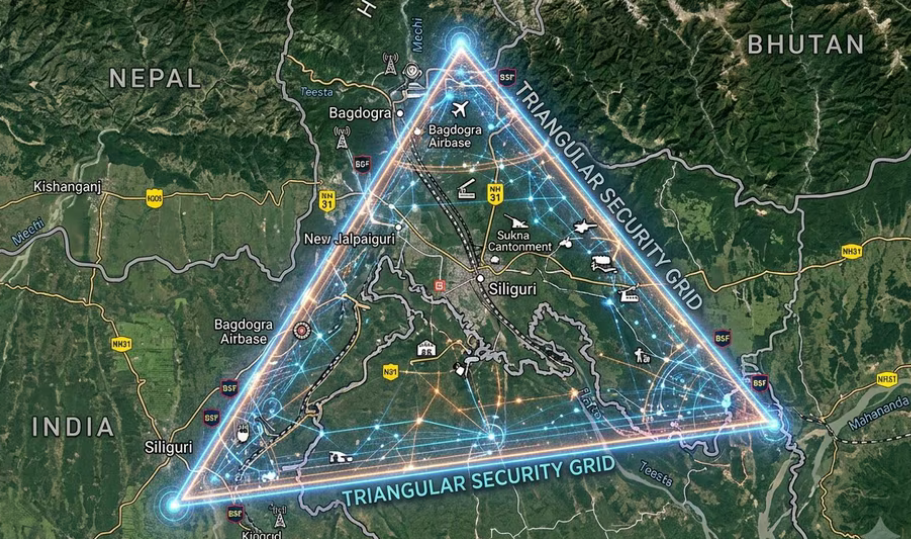
From a triangular security grid around the Siliguri Corridor to a massive railway upgrade along sensitive international borders, India appears to be knitting together a new architecture of territorial defence—one that combines boots on the ground with the speed of strategic mobility.
The Centre's decision to build a special “Triangular Security Grid” around the strategically vital Siliguri Corridor, popularly known as the Chicken’s Neck, and reports of a proposed Rs 45,000-crore investment to strengthen railway infrastructure along India's international borders together underline a fundamental shift in New Delhi's security thinking.
The message is unmistakable: in modern warfare, defending a frontier is no longer merely about deploying soldiers along the border. It is equally about ensuring that troops, weapons, ammunition, supplies and reinforcements can move swiftly when a crisis erupts.
The Siliguri Corridor lies at the heart of this strategic calculation.
This narrow strip of land is India's only terrestrial link between the mainland and the eight northeastern states. Flanked by Nepal, Bhutan and Bangladesh, and located not far from the sensitive India-China frontier, the corridor represents one of the country's most geographically vulnerable strategic place.
Any serious disruption here could potentially affect India's connectivity with the Northeast—making its security far more than a regional concern.
New Defence Architecture: Amit Shah
It is against this backdrop that Union Home Minister Amit Shah announced the creation of a special Triangular Security Grid to strengthen the Chicken's Neck. T
The new defensive architecture is anchored around three strategically important locations—Dhubri in Assam, Kishanganj in Bihar and Chopra in West Bengal.
New garrisons in these three areas are expected to create a broad protective triangle around the vulnerable corridor, enabling security agencies to maintain greater surveillance, improve coordination and respond faster to any emerging threat.
But the significance of the development goes beyond geography.
The proposed grid reflects a growing recognition that India's vulnerable corridors and border regions cannot be secured through isolated military or paramilitary deployments. They require an integrated security ecosystem—combining intelligence, infrastructure, rapid deployment capability and constant logistical preparedness.
Why Railway Expansion Is Crucial
And this is where the proposed railway expansion assumes enormous strategic significance.
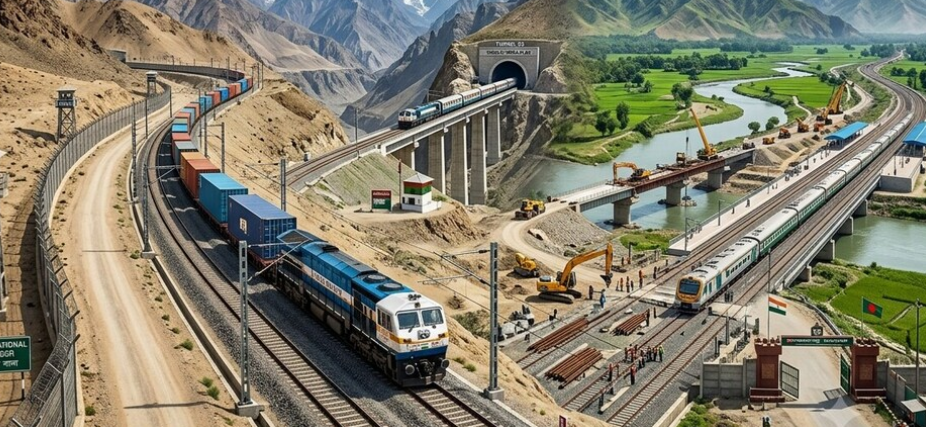
According to a Bloomberg report quoting officials familiar with the plan, India is considering an investment of around Rs 45,000 crore over the next 18 to 24 months to strengthen railway connectivity along areas bordering Bangladesh, China and Pakistan.
New railway lines, platforms and related infrastructure could come up in border regions across West Bengal, the Northeast, Assam, Punjab, Rajasthan and Himachal Pradesh.
For civilians, such projects could open up new opportunities for trade, employment and economic development. But for India's defence establishment, railway infrastructure carries an equally crucial strategic value.
A railway line can become a logistical artery in peace and a military lifeline in crisis.
In the event of a military emergency, troops equipped with rations, fuel, weapons and ammunition can be transported rapidly towards sensitive sectors.
Himalayan Terrain: Lessons To Be Learnt
In difficult Himalayan terrain or strategically fragile areas such as the Siliguri Corridor, the ability to sustain forces may ultimately become as important as the number of soldiers deployed.
The combination of the triangular security grid and border railway modernisation therefore points towards a larger national strategy.
In the aftermath of devastating calamity in the Tibet-Nepal border, defence experts believe India needs to proceed cautiously to ensure that its borders are not merely guarded—but are connected, supplied, reinforced and resilient.
For decades, border infrastructure was often viewed primarily through the lens of development. Today, that distinction is rapidly disappearing. A new logistics hub can simultaneously serve the civilian population and strengthen national defence.
The Chicken's Neck remains the most dramatic symbol of that challenge.
India cannot change its geography. But through infrastructure, technology and layered security, it can reduce geography's vulnerabilities.
The emerging security architecture suggests precisely that ambition: to turn India's vulnerable frontiers from potential pressure points into zones of preparedness—where the distance between a threat and a national response is measured not in days, but in hours.
About the Author

Prasanta Paul served Deccan Herald as the Chief of Bureau, Calcutta for nearly two decades before switching to work with various TV channels such as Al-Jazeera, CNN, German TV and CBS. He also headed the Eastern Bureau of Parliamentarian magazine. Mr. Paul who accompanied former Prime Minister Atal Behari Vajpayee on his overseas tour of Singapore and other Asian countries, travelled extensively to Bhutan, Sikkim and Darjeeling besides other Northeastern states. He briefly headed the Mizoram Bureau of the United News of India (UNI).
Discussion
Reader Comments
No comments yet. Be the first to share your perspective.