BreakingNational
Jantar Mantar: When Confusion Clouds the Cause & Path of its Clarity
A staggering list of paper leaks in various states across India is being overlooked
24 Jul 2026, 10:47 am IST·4 min read
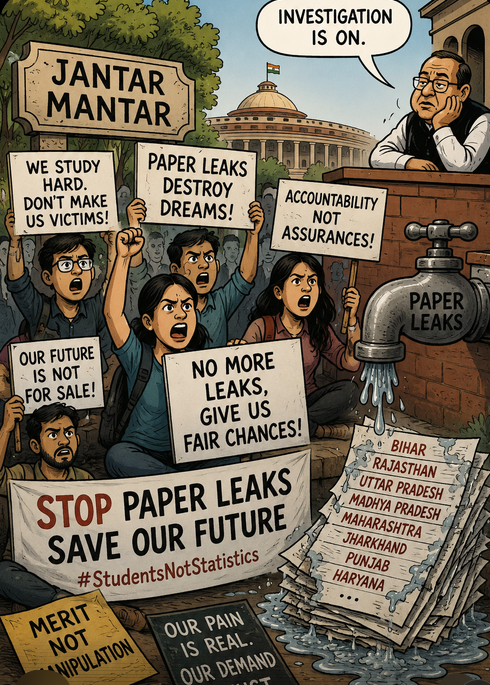
An intricate maze of confusion has currently enveloped the ongoing students’ agitation at New Delhi’s Jantar Mantar.
Starting from a post of popular singer Arijit Singh who subsequently was believed to have revised it, wife of Sonam Wangchuk condemning the Congress’ sit-in before the residence of the Prime Minister to innumerable posts in various social media depicting the rank ignorance of the student-participants about the actual reason behind their joining the protest and a staggering list of paper leaks in various states across India since 2005-06 –-- all have left majority of the liberal-minded Indians here and abroad in a state of shock and utter wonder.
A Reuters report quoting a food delivery boy claimed that they ‘are ferrying donations from supporters from India and abroad (who are) unable to join a rare display of public dissent against Prime Minister Narendra Modi’s government.’
“From Kerala to USA, orders are coming from everywhere,” the report quoted rider Suraj Kumar,25 as saying.
A plethora of questions that are being parried away by the opposition leaders espousing the cause of the protest of the so-called Gen Z include who instigated the mindless violence first and why.
The sequence of events that led to the violence remains contested, with different sides offering sharply divergent accounts. Official figures indicate that more than 110 police personnel were injured, while reports also said around 20 protesters sustained injuries during the baton-charge.
Establishing responsibility requires an impartial investigation rather than competing political narratives.
What is equally strange as well as shocking is that protesters have refused to pay attention to what students who appeared NEET-2026 and missed their chance, had to say or more importantly, what their parents felt about this ongoing protest-cum-violence.
Irony of Paper Leaks
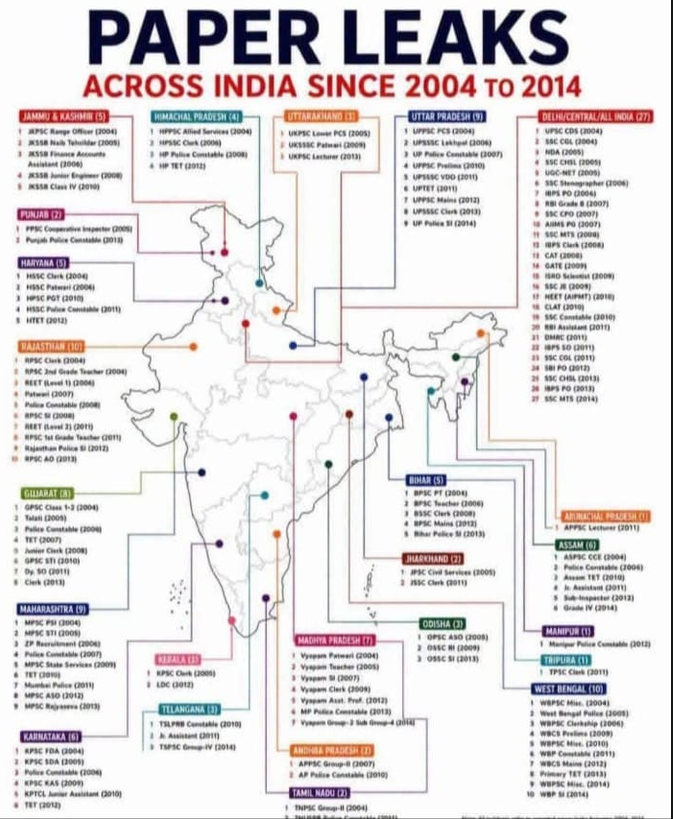
The irony is impossible to miss. Long before the present agitation erupted in the capital, examination paper leaks had become one of India's most persistent governance failures. The accompanying map tells a story that predates the current political battle by nearly two decades.
From recruitment examinations to entrance tests, from state public service commissions to police recruitment, teachers' eligibility tests and university admissions, allegations of paper leaks have surfaced across states ruled by almost every major political party.
The geography of the problem is striking because it refuses to conform to political boundaries. It is neither a phenomenon confined to BJP-ruled states nor to Opposition-ruled ones. Rather, it has exposed systemic weaknesses in the examination ecosystem itself.
That is where the present debate risks losing its moral clarity.
For any student, the theft of an examination paper is not merely an administrative lapse. It represents the theft of years of preparation, emotional investment and family sacrifice. Every leaked paper erodes confidence in meritocracy and strengthens the perception that honest candidates are competing against organised rackets rather than fellow aspirants.
Seen through that prism, the outrage visible at Jantar Mantar is understandable. What is less understandable is why the public discourse has shifted so rapidly from the larger question of examination integrity to a politically polarised debate over protests, policing and competing narratives on social media.
Real Victims Have Little Voice
The consequence is that the original victims—the lakhs of students whose careers have been disrupted by recurring examination scandals—risk becoming secondary characters in a confrontation dominated by political parties, influencers and ideological camps.
The map reinforces this uncomfortable truth. It demonstrates that paper leaks have been reported repeatedly over the years in states governed by different parties and different coalitions. If the objective is to restore faith in India's examination system, then selective outrage cannot provide the solution. A problem that is national in scale demands a response that is equally national.
The conversation, therefore, ought to move beyond asking which government is embarrassed today. The more relevant question is why successive governments—irrespective of political colour—have failed to build an examination architecture capable of resisting organised criminal networks that profit from leaked question papers.
That perhaps is the central tragedy of the present agitation. Instead of evolving into a national movement demanding structural reforms—encrypted digital question transmission, greater accountability of examination agencies, harsher punishment for organised leak syndicates, time-bound investigations and compensation for affected candidates—the movement increasingly finds itself trapped in the familiar binaries of government versus Opposition, police versus protesters and Left versus Right.
In that cacophony, the student preparing in a small town with borrowed books and immense hope once again risks being forgotten.
The real story is not merely the protest at Jantar Mantar. It is that two decades of recurring paper leaks across India have created a crisis of trust in merit, and the current agitation risks being consumed by politics before that deeper institutional failure is addressed.
Well, all this doesn't rob the right to protest; it only reeks of something else….
About the Author
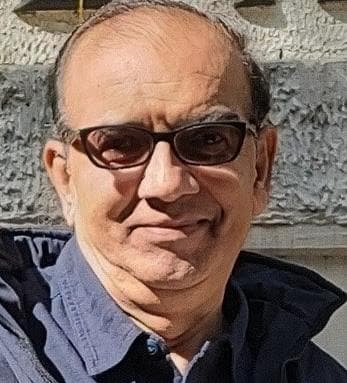
Prasanta Paul served Deccan Herald as the Chief of Bureau, Calcutta for nearly two decades before switching to work with various TV channels such as Al-Jazeera, CNN, German TV and CBS. He also headed the Eastern Bureau of Parliamentarian magazine. Mr. Paul who accompanied former Prime Minister Atal Behari Vajpayee on his overseas tour of Singapore and other Asian countries, travelled extensively to Bhutan, Sikkim and Darjeeling besides other Northeastern states. He briefly headed the Mizoram Bureau of the United News of India (UNI).
Discussion
Reader Comments
No comments yet. Be the first to share your perspective.