BreakingInternational
Kolkata–Biratnagar Freight Train a New Milestone in Indo-Nepal Economic Integration
India is quietly replacing border logistics with corridor logistics
29 Jul 2026, 01:19 pm IST·3 min read
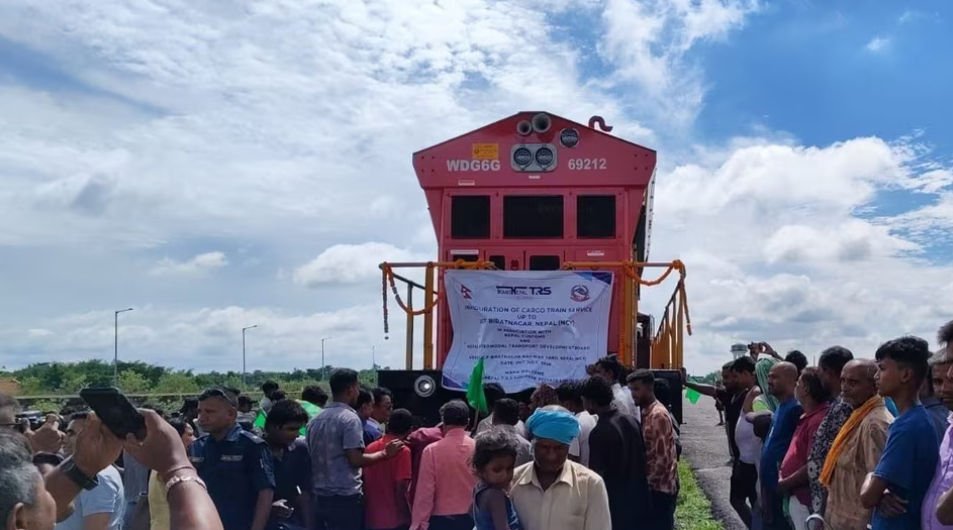
India and Nepal have taken a significant step towards deepening cross-border economic integration with the successful inauguration of the maiden commercial container freight train from Kolkata Port directly to Nepal's Biratnagar Customs Yard.
The train, with 40 cargo-loaded wagons, marks much more than the completion of another freight journey. It represents the first practical implementation of the revised India-Nepal Rail Transit Protocol, allowing cargo originating at Kolkata Port to reach Nepal by rail without the need for any transshipment at the border.
The new system eliminates one of the biggest bottlenecks in India-Nepal trade. Until now, cargo entering Nepal generally had to be unloaded at the border and transferred to another mode of transport before proceeding to its destination.
The direct rail movement significantly reduces handling, cuts transit time, lowers logistics costs and minimizes the risk of cargo damage, making bilateral trade faster and more economical.
For landlocked Nepal, whose overseas trade depends overwhelmingly on Indian transit infrastructure, the new arrangement is particularly significant.
Direct rail connectivity with Kolkata Port provides a more reliable supply chain for imports while making exports more competitive through lower transportation costs.
The breakthrough has been made possible by the broad-gauge railway connecting Jogbani in Bihar with Biratnagar in Nepal. The line was jointly inaugurated in June 2023 by Prime Minister Narendra Modi and Nepal's then Prime Minister.
The signing of the revised Letter of Exchange in November 2025 subsequently created the legal and operational framework for commercial freight services. The arrival of the first container train now translates those diplomatic understandings into operational reality.
Strategic Significance of the Connectivity
Beyond transportation efficiency, the development carries considerable strategic significance.
At a time when South Asian economies are seeking stronger regional connectivity, India is steadily shifting from being merely a transit country to becoming an integrated logistics partner for its neighbours.
The project aligns with New Delhi's broader "Neighbourhood First" policy, which seeks to strengthen regional ties through connectivity, infrastructure and trade rather than diplomacy alone.
The direct freight corridor also complements India's wider efforts to modernize multimodal logistics linking ports, railways and land borders. By integrating Kolkata Port with Nepal's industrial centres through uninterrupted rail movement, India is strengthening eastern India's role as a gateway for Himalayan trade.
The timing is equally important. Global supply chains are increasingly emphasizing reliability, lower logistics costs and faster delivery. Efficient rail-based freight movement offers a more sustainable alternative to long-distance road transport while improving predictability for businesses operating across borders.
For Nepal, improved access to maritime trade routes through India enhances economic resilience by reducing transportation delays and lowering transaction costs. For India, deeper logistical integration with Nepal strengthens long-term economic interdependence and reinforces its position as the principal connectivity partner in the Himalayan region.
The successful operation of the inaugural commercial container train also demonstrates that bilateral infrastructure projects are beginning to move beyond symbolic inaugurations into regular commercial operations.
The Northeast Frontier Railway views the project as a key component of its efforts to promote regional connectivity, deploy modern railway infrastructure and deepen economic cooperation with neighbouring countries.
Officials believe the corridor will not only boost bilateral trade between India and Nepal but also reinforce the broader architecture of regional connectivity in South Asia, providing a model for more efficient cross-border logistics in the years ahead.
About the Author

Prasanta Paul served Deccan Herald as the Chief of Bureau, Calcutta for nearly two decades before switching to work with various TV channels such as Al-Jazeera, CNN, German TV and CBS. He also headed the Eastern Bureau of Parliamentarian magazine. Mr. Paul who accompanied former Prime Minister Atal Behari Vajpayee on his overseas tour of Singapore and other Asian countries, travelled extensively to Bhutan, Sikkim and Darjeeling besides other Northeastern states. He briefly headed the Mizoram Bureau of the United News of India (UNI).
Discussion
Reader Comments
No comments yet. Be the first to share your perspective.