BreakingCreative Corner
The Colonial Way of Taxing Our Taste: The Great Hedge of India
A wall, not made of stone but of thorns
02 Oct 2026, 08:13 am IST·7 min read
Picture yourself on the plains of central India in 1860s. In front of you lies a wall, not made of stone or brick, but of thorns.
It is 12 feet high and 14 feet thick at the base, extending left and right as far as the eye can reach until it disappears into the horizon; it is a wild, twisting mass of thorny babool, karonda and bamboo.
There is no gate and no opening, merely thorns with armed guards behind them keeping watch for the offence of carrying salt.
This was the Great Hedge of India: a customs barrier 2,300 miles long, the same distance as from London to Constantinople, which had been grown with the sole purpose of taxing the taste of salt on every Indian’s tongue.
When people recall the dark period of colonisation, they usually associate it with exploitation, taxation, murder, and man-made famine. Just as salt improves the taste of food and a meal is not proper without it, so too was colonialism incomplete in the absence of exploitation and taxation.
Yet what if one of our most ordinary household items had been subject to a tax?
Although you may have heard of the Great Wall of China, have you ever come across the Great Hedge of India?
If your answer is no, then allow me to take you on a journey through my story, during which you will discover how the British taxed our sense of taste by imposing a duty on salt.
A book obtained second-hand and a footnote: The Discovery of “The Great Hedge”
The British writer Roy Moxham came upon the Great Hedge of India in 1998. Having bought a second-hand book called Rambles and Recollections of an Indian Official by Sir William Sleeman (1844) in 1995, Roy noticed that the book contained short mentions of a customs post at Horal in Central India.
This came as a surprise to him since he had not been aware that there were any inland customs barriers in British India.
Fortunately, he came across a footnote which cited The Finances and the Public Works of India, 1869-1881 by Sir John Strachey and Richard Strachey: A system was gradually developed in order to impose a duty on salt, so extensive that it could hardly be found in any fairly civilised country.
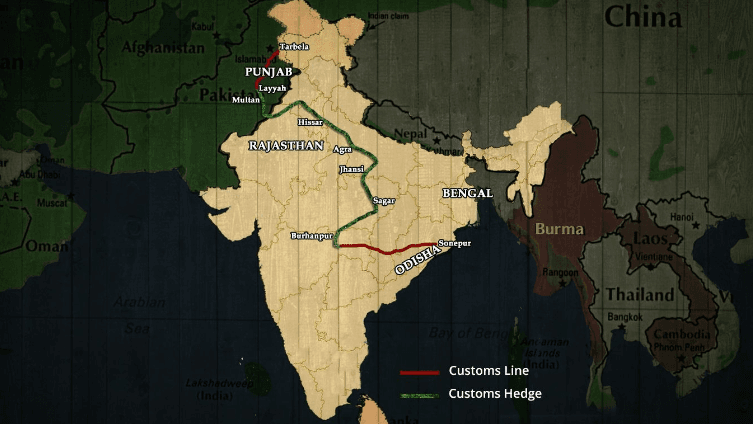
A Customs Line was set up stretching throughout India, and in 1869 it ran from the Indus to the Mahanadi in Madras, a distance of 2300 miles (3700 km) it was manned by nearly 12,000 men.
The line would have reached from London to Constantinople; it was mainly made up of a huge impenetrable hedge of thorny trees and bushes.
Constructing the “Monstrous thorny System”
The Inland Customs Line was set up in 1823 in order to impose a very high tax on salt in the eastern third of British India, a region covering an area of 1,295,000 square km in which the availability of salt was very low.
It was constructed to stop salt from being smuggled in from the rest of India, where salt was being produced, and there was also a small tax on sugar moving in the opposite direction.
At first, it consisted simply of a series of customs posts situated along the roads and rivers. Eventually, the section extending almost from the Indus (at Multan) to the eastern sea (at Odisha) was transformed into a thorny hedge made up of babool, karonda and bamboo.
This hedge was 12 feet (3.7 m) high and 14 feet (4.3 m) thick at its base. The Great Hedge was not a single continuous wall since rivers such as the Indus, Sutlej and Yamuna acted as natural barriers, while trenches and embankments were used to reinforce the other parts.
The Cost of a Taste
During the period 1869 to 1870 the Inland Customs Line collected a salt tax amounting to about 1.25 crore rupees, the cost of running the system being approximately 16.2 lakh rupees. By 1877 salt tax revenue throughout British India had increased to roughly 6.3 million pounds; salt, being a basic necessity for every household, had become extremely valuable to the British Raj.
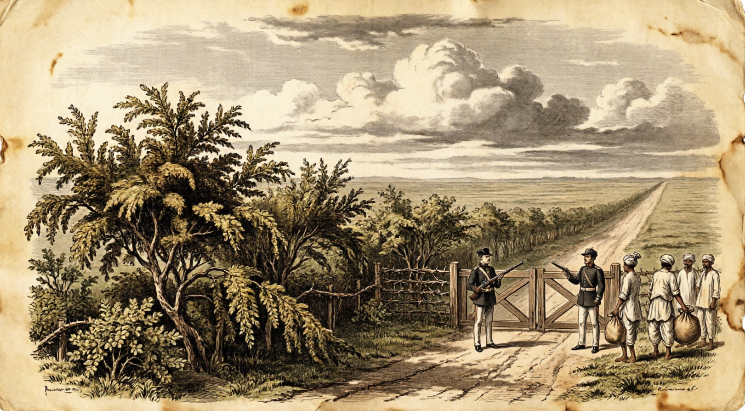
Armed guards inspecting peasants carrying sacks of salt at the Inland Customs Line
Among the Thorns: The War of the Smugglers
The smugglers weren’t going to remain silent and accept their losses.
Although a hedge four feet thick seemed hard to go through, it wasn’t impossible. The salt smugglers located weak spots, cut or set on fire parts of the hedge, and looked for ways to go around the barriers. Armed groups drove camels loaded with sacks of salt straight through the living wall, while others tossed sacks over the hedge to accomplices who were on the other side.
Even though the British had a thorny fence, the smugglers had time, creativity, and a motive for getting over it.
The Human Cost: Blood on the Thorns
The enforcement was just as severe as the hedge itself. When it was at its height, the border was watched over by almost 12,000-armed men and was headed by officials such as Allan Octavian Hume, the same Hume who afterwards founded the Indian National Congress.
The guards marched mile upon mile in the scorching sun and could be punished if the hedge in their area died or was broken; for the living wall had enemies besides smugglers, since wind, fire, white ants, rats and mould constantly attacked it. People caught smuggling were subjected to fines, imprisonment and the seizure of their cattle and carts as a punishment for the ‘crime’ of carrying what the sea had given freely.
The villages situated along the line had to live under constant suspicion: a small amount of salt in the wrong pocket could destroy a family. The hedge did not simply divide up the land; it separated people from their own soil, from their own markets, and from their own tastes.
The Death of the Hedge: 1st April 1879
No matter how monstrous a system may be, it will eventually collapse not always because of moral reasons, but frequently because of the high cost involved. It was incredibly expensive to maintain a living fence stretching over 2,300 miles, and smuggling had never really ceased.
When the end finally came, it was not the result of mercy but of mathematical calculation: after the British had taken control of the Sambhar salt lake in Rajasthan, they found that it was much cheaper to impose a tax on salt at the time of production than to keep guard over a fence spanning a subcontinent.
A uniform salt duty was introduced throughout British India, and on 1 April 1879, the Inland Customs Line was formally abolished. The guards were dismissed, the gates were opened and the huge fence was just left to decline.
Within a few decades, nature and agricultural ploughing had almost completely removed all traces of the longest hedge ever known.
Why We Forgot
It is rather hard to understand why the Great Hedge of India has disappeared from our memory. One explanation may be the fact that the emphasis has been placed on Mahatma Gandhi’s campaigns, the Salt March of 1930 became known as the ‘Salt Story’ and all that came before it has thus faded into obscurity.
We Indians are very good at forgiving and forgetting, but the farmers who would have suffered most from the high taxes and the difficulties of the barrier were mostly uneducated and therefore, left no written records.
It is very surprising that even our folk memory has not preserved the tale, a wall of thorns which had once divided a nation, should at least have survived in song and story. Maybe that is the final cruelty of the hedge which has been wiped out of the land and then erased from memory.
Yet, every time we put salt on our food without any fear, we should remember our ancestors for what they paid for that taste.
About the Author

Suraj Mishra is a final-year postgraduate student pursuing MA in Journalism and Mass Communication at the Centre for Journalism and Mass Communication (CJMC), Visva-Bharati. Suraj nurtures a passion for media and effective communication which drives him to focus and write news features, with a particular interest in Indian Knowledge system and Development Communication.
Discussion
Reader Comments
No comments yet. Be the first to share your perspective.