BreakingCreative Corner
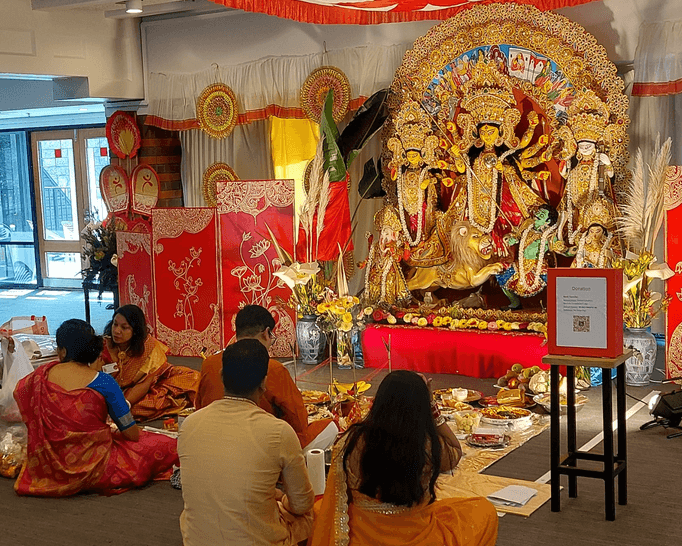
When India’s Folk Art Comes Alive in Durga Puja’s Canvas
Radiance of the Goddess’s Third Eye captivates the crowd
14 Oct 2026, 10:36 am IST·3 min read
The autumn sun washes the fields, wetlands and forests in gold. The sky turns an unblemished blue, white kash flowers sway in the breeze, and the fragrance of shewli blossoms mingles with the sight of paddy fields stretching towards the horizon.
In the waking city, morning tea sends curls of steam into the air. Autumn has arrived—and with it, the unmistakable anticipation of Durga Puja.
Now, imagine this seasonal landscape springing to life on a canvas. A multitude of colours fills modest workshops, where artists work their magic with brushes, pigments and folds of fabric.
Amid their intricate patterns emerge the elongated eyes of the Goddess and the radiant brilliance of her third eye. The familiar image of Durga acquires a new identity, shaped by the imagination of artists from different corners of India.
Here, the stories unfold through Bengal’s Patachitra scroll paintings; there, Maharashtra’s ancient Warli art casts its spell. Elsewhere, Odisha’s Patachitra lends its distinctive visual vocabulary to the festive spectacle.
Durga Puja has long transcended the boundaries of ritual and religious observance to become a celebration of community, creativity and collective belonging.
Its cultural significance received international recognition in December 2021, when Durga Puja in Kolkata was inscribed on UNESCO’s Representative List of the Intangible Cultural Heritage of Humanity.
Artistic Evolution of Durga Puja
The festival’s artistic evolution is particularly visible in its themed pandals, where ‘installation art’ transforms temporary spaces into immersive experiences. Architecture, sculpture, painting and indigenous craft converge to create elaborate artistic environments.
Behind these spectacular creations stand folk artists whose painstaking craftsmanship gives each installation its distinctive character.
In the early years of the themed-puja movement, Bengal’s own traditional art forms dominated the decorative landscape. Bishnupur’s terracotta, Krishnanagar’s clay figurines, Burdwan’s woodcraft, Fulia’s handloom textiles, Dinajpur’s masks and Midnapore’s mats and Patachitra became integral to pandal design.
Today, the artistic boundaries have expanded well beyond the state. The Gond paintings of central India, the tribal Warli tradition of Maharashtra and Bihar’s celebrated Madhubani art are finding prominent places in Kolkata’s festive imagination.
The result is a remarkable convergence of regional traditions, each carrying the memory and lived experiences of its community.
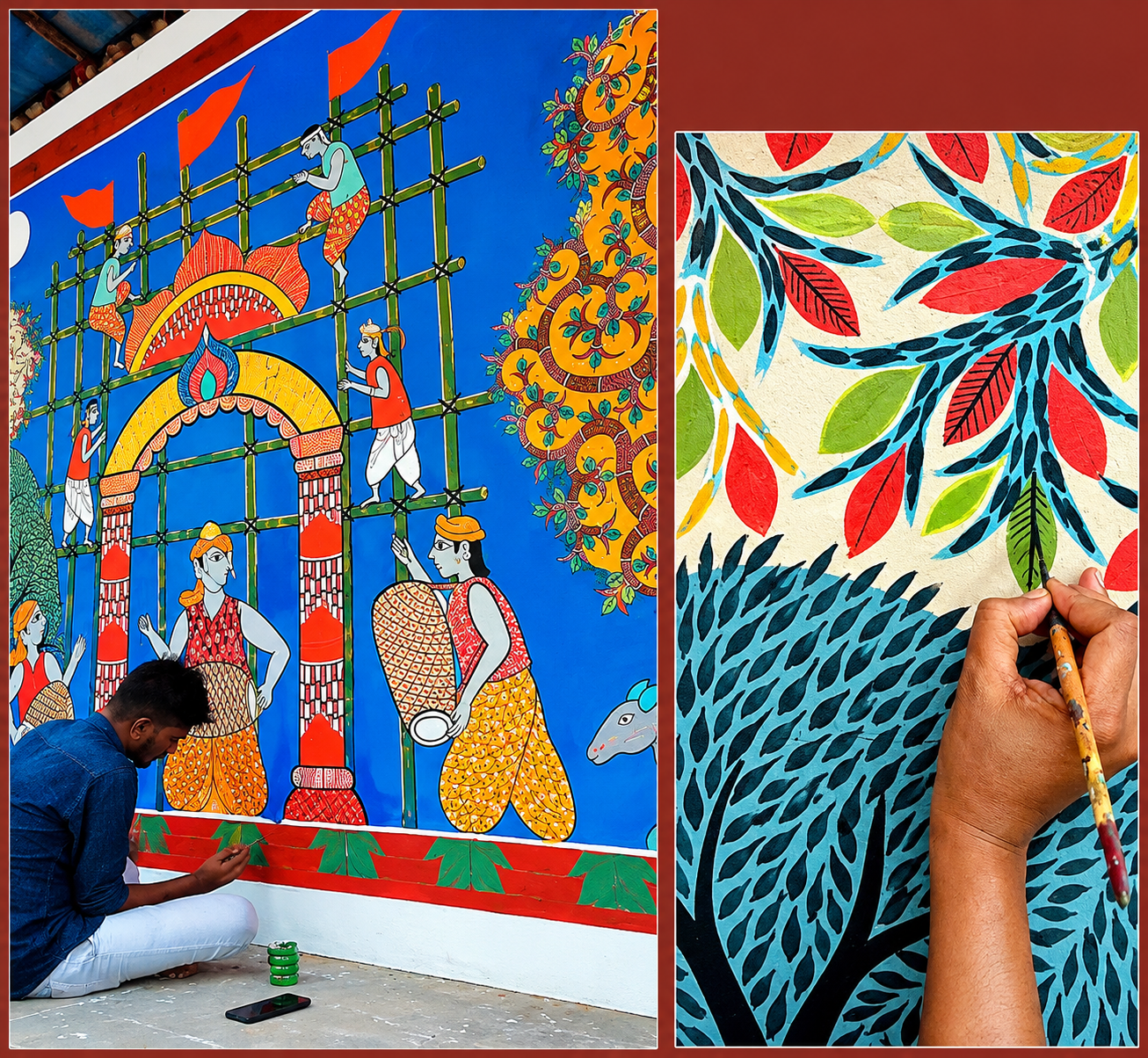
At South Kolkata’s 66 Pally, for instance, the theme draws inspiration from Warli painting, an ancient folk-art tradition associated with the Warli tribal community of Maharashtra’s northern Sahyadri region.
Using simple geometric forms—circles, triangles and squares—artists portray everyday life, farming, dancing, festivals and community relationships.
Their deceptively minimal compositions tell stories of a world where human beings remain closely connected to nature and one another.
Odisha’s Patachitra offers another window into India’s living artistic heritage. Raghurajpur, a heritage village near Puri, is renowned for this traditional painting style. Several families continue to practise the craft, preserving techniques and visual traditions passed down through generations.
Madhubani Art of Bihar
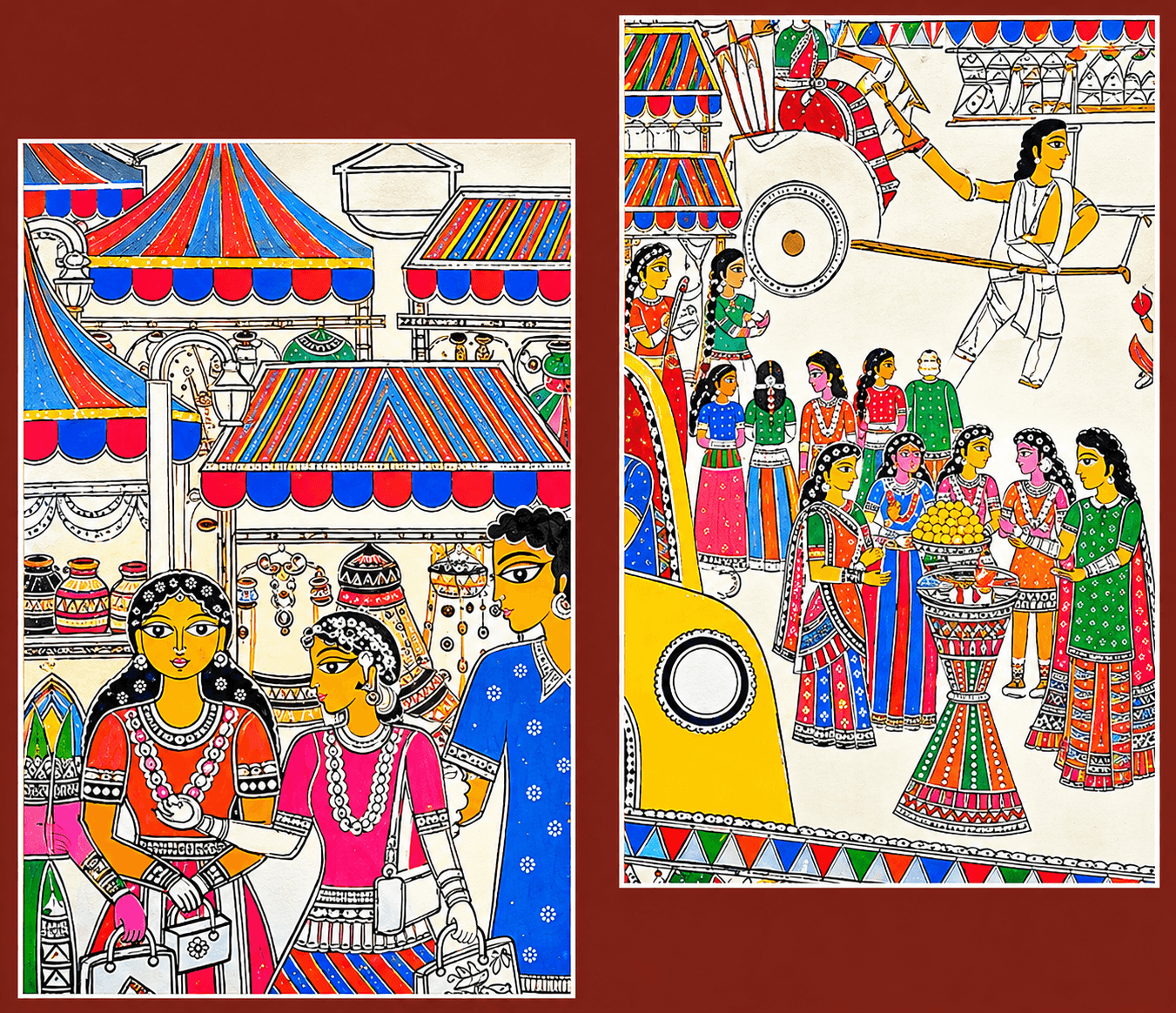
Meanwhile, Madhubani artists from Bihar are discovering Kolkata through their own distinctive idiom. The city’s iconic yellow taxis, roadside tea stalls, neighbourhood rock-er adda—the quintessential Bengali gathering on street-side ledges—rickshaws, trams and phuchka vendors are appearing on Madhubani canvases.
Five artists from Bihar are weaving the sights and rhythms of old Kolkata into a visual language born in the Mithila region.
This is more than decorative ingenuity. It is a cultural conversation across geographical boundaries, in which one region’s artistic inheritance discovers fresh expression in another’s most beloved festival.
For the folk artist, the pandal becomes a canvas; for the city, it becomes a living museum. And for Durga Puja, every brushstroke adds another dimension to its enduring appeal—a celebration in which tradition does not remain frozen in time but travels, adapts and flourishes.
As the Goddess arrives beneath Bengal’s autumn sky, India’s diverse folk traditions arrive with her. In their colours, patterns and stories, the festival discovers a larger truth: art can cross borders without losing its roots, and a local celebration can become a national cultural tapestry.
About the Author
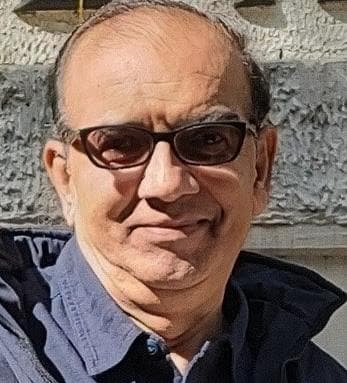
Prasanta Paul served Deccan Herald as the Chief of Bureau, Calcutta for nearly two decades before switching to work with various TV channels such as Al-Jazeera, CNN, German TV and CBS. He also headed the Eastern Bureau of Parliamentarian magazine. Mr. Paul who accompanied former Prime Minister Atal Behari Vajpayee on his overseas tour of Singapore and other Asian countries, travelled extensively to Bhutan, Sikkim and Darjeeling besides other Northeastern states. He briefly headed the Mizoram Bureau of the United News of India (UNI).
Discussion
Reader Comments
No comments yet. Be the first to share your perspective.