BreakingInternational
The Living Nostradamus and the Age of Global Anxiety
Why Prophecy Is Making a Unique Comeback Worldwide
04 Aug 2026, 01:25 pm IST·4 min read

When intelligence agencies warn of cyber warfare and a Brazilian fortune teller predicts much the same thing, where does prophecy end and geopolitics begin?
That question is helping propel Athos Salomé, the 36-year-old Brazilian widely known as the "Living Nostradamus", into the global spotlight.
Over the past few years, the self-styled seer has attracted millions of followers by claiming to have anticipated several major developments in world politics, technology and international security.
A number of his forecasts, admirers argue, have coincided with subsequent events, while sceptics dismiss them as broad predictions interpreted after the fact.
Whatever the verdict, Salomé's growing popularity tells a larger story. In an era marked by wars, artificial intelligence, cyberattacks and intense rivalry among global powers, predictions about the future are finding an increasingly receptive audience.
Salomé’s Predictions
Salomé has now claimed that two of his major forecasts for 2026 have already come true. Buoyed by what he considers successful predictions, he has issued a fresh warning that the second half of the year could witness a new phase of confrontation between the world's leading military and economic blocs—not fought primarily with tanks and missiles, but with algorithms, satellites, cyber weapons and biotechnology.
According to Salomé, his first successful prediction involved disruption of global aviation and communications through sophisticated cyber operations or AI-enabled attacks. He points to recent technology failures affecting airline networks, flight cancellations and digital outages as developments consistent with his forecast.
His second claimed success centres on the growing strategic competition over space. As major powers accelerate investments in military satellites, anti-satellite capabilities and electronic warfare, the emerging contest, Salomé says, mirrors the geopolitical direction he had anticipated.
Whether these developments genuinely validate his forecasts is open to debate. What is beyond dispute, however, is that cyberspace and outer space have become critical frontiers of modern warfare.
Russia-Ukraine Conflict & Cyberattacks
The Russia-Ukraine conflict demonstrated this reality even before conventional military operations began. In the run-up to Moscow's 2022 invasion, coordinated cyberattacks targeted Ukrainian government networks, while the AcidRain malware disabled thousands of modems connected to the Viasat KA-SAT satellite network.
The disruption significantly affected communications, illustrating how digital attacks can precede and complement conventional warfare. For military planners across the world, it was an unmistakable signal that future conflicts would increasingly unfold through invisible digital infrastructure as much as on physical battlefields.
It is against this backdrop that Salomé's latest warning has attracted worldwide attention.
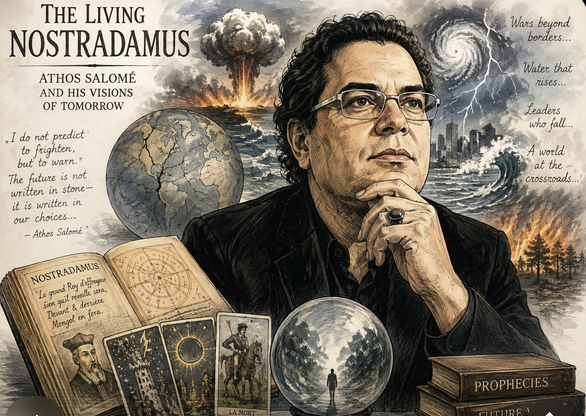
The months ahead, he cautions, could witness escalating competition between rival global blocs, with artificial intelligence, cyber capabilities, satellite networks and biotechnology emerging as the principal instruments of strategic confrontation.
Instead of traditional battlefields alone, future conflicts may target financial systems, electricity grids, communications infrastructure and transportation networks, blurring the distinction between war and peace.
Whether one accepts Salomé's conclusions or not, the underlying concerns are hardly imaginary. Governments across the world are investing billions of dollars in cyber security, AI-powered defence systems, quantum technologies and resilient satellite infrastructure precisely because these domains are now recognised as decisive strategic assets.
Intelligence agencies increasingly warn that the next major conflict may begin with a keyboard long before the first missile is launched.
That perhaps explains why figures such as Salomé continue to capture the public imagination. Every period of profound uncertainty has produced individuals claiming to foresee the future.
Message of Salomé
During the Cold War, fears centred on nuclear annihilation. Today, the anxieties are different but no less profound. Artificial intelligence is transforming warfare, satellites have become military targets, and cyberattacks possess the ability to paralyse entire nations without firing a single shot.
Salomé insists that his predictions are not intended to spread fear but to encourage preparedness. According to him, timely international cooperation and responsible use of emerging technologies can still prevent many of the crises he foresees.
His message may ultimately be judged right or wrong. Yet the real significance of his popularity lies elsewhere. It reflects a world struggling to keep pace with technological change and geopolitical upheaval—a world where algorithms shape economies, cyber weapons challenge national security and artificial intelligence is redefining military power.
Perhaps the real significance of Athos Salomé lies not in whether he can predict the future, but in what his popularity reveals about the present. In an age where artificial intelligence writes code, satellites guide wars and cyberattacks can cripple nations without a single shot being fired, prophecy has found an unusually receptive audience.
The "Living Nostradamus" may or may not foresee tomorrow, but he has certainly captured the anxieties of today.
About the Author
Prasanta Paul served Deccan Herald as the Chief of Bureau, Calcutta for nearly two decades before switching to work with various TV channels such as Al-Jazeera, CNN, German TV and CBS. He also headed the Eastern Bureau of Parliamentarian magazine. Mr. Paul who accompanied former Prime Minister Atal Behari Vajpayee on his overseas tour of Singapore and other Asian countries, travelled extensively to Bhutan, Sikkim and Darjeeling besides other Northeastern states. He briefly headed the Mizoram Bureau of the United News of India (UNI).
Discussion
Reader Comments
No comments yet. Be the first to share your perspective.