BreakingInternational
The Mecca Defence Pact To Quietly Tilt the Gulf Chessboard in India's Favour?
Friday's deal makes the balancing act more difficult for Pakistan
08 Aug 2026, 11:10 am IST·4 min read
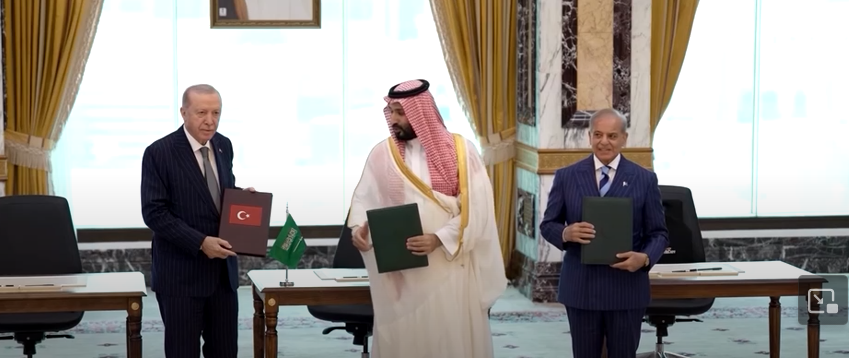
India may have had no seat at the negotiating table, yet New Delhi could emerge as one of the quiet strategic beneficiaries of the defence agreement signed by Saudi Arabia, Pakistan and Turkey in Mecca on Friday.
The treaty, bringing together three influential Sunni Muslim powers under a stronger security framework, is unlikely to alter the military balance overnight. Its real significance lies elsewhere.
The pact redraws regional political perceptions, complicates Pakistan's diplomatic balancing act and, in the process, enhances India's standing as a comparatively neutral and dependable partner in an increasingly polarised Gulf.
For Iran, world's most populous Shia Muslim-majority nation, the agreement is bound to be viewed with caution.
The immediate backdrop to the pact was Saudi Arabia's reported military assessment that Yemen's Houthi rebels and Iranian-backed Iraqi militias had coordinated plans to target the kingdom under the supervision of Iran's Islamic Revolutionary Guard Corps (IRGC).
Whether or not Tehran accepts that assessment, the treaty unmistakably signals that Riyadh is tightening its security architecture against what it perceives as an expanding Iranian regional footprint.
Pakistan's participation therefore assumes significance far beyond a routine defence understanding.
Islamabad has, throughout the six-month-long Gulf conflict, projected itself as an intermediary capable of maintaining communication between Tehran and Washington while simultaneously preserving close strategic ties with Saudi Arabia.
This balancing act has always been delicate. Friday's agreement makes it considerably more difficult.
Pakistan is already linked to Saudi Arabia through defence commitments that envisage military assistance in the event of external aggression. By joining another trilateral security arrangement alongside Riyadh and Ankara, Islamabad inevitably deepens the perception that its strategic priorities remain firmly aligned with the Sunni bloc.
That perception alone may prove costly.
Because, besides Turkey, Syria, Libya and Iraq are all Sunni majority countries.
Diplomatic mediation depends not merely on trust but also on the appearance of neutrality. Once either side begins questioning the mediator's impartiality, the value of the intermediary diminishes rapidly.
Iran suddenly finds itself in crosshairs. Tehran may now be asking an uncomfortable question: can Pakistan simultaneously remain a credible bridge to Iran while becoming more deeply embedded in Saudi Arabia's evolving security architecture?
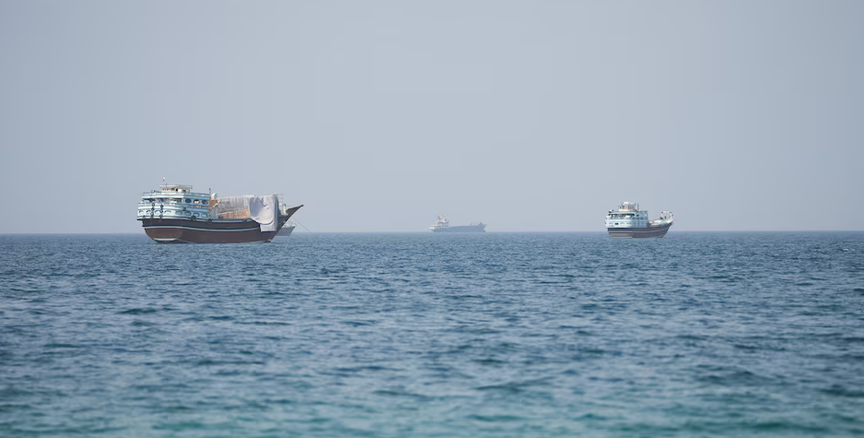
Vessels in Strait of Hormuz
Pakistan in a Catch 22
Those doubts had begun surfacing even before Friday's agreement. Sections of the US Senate had reportedly questioned Islamabad's role after allegations that Pakistan quietly permitted Iranian fighter jets to use the Nur Khan Air Base to shield them from possible American strikes. Whether those allegations are ultimately substantiated or not, they reflected the extraordinary complexity of Pakistan's diplomatic position—attempting to reassure rivals who increasingly distrust one another.
The Mecca agreement only intensifies that dilemma.
This is where India quietly stands to gain.
Unlike Pakistan, New Delhi has consciously avoided becoming part of any military bloc in the Gulf. Over the past decade it has cultivated robust strategic partnerships with Saudi Arabia, the United Arab Emirates and Israel while simultaneously preserving functional relations with Iran despite periods of Western sanctions.
That policy of strategic autonomy now appears increasingly valuable.
Interestingly though, Prime Minister Narendra Modi and Israeli Prime Minister Benjamin Netanyahu held a telephone interaction on Thursday, deliberating on avenues to advance the India-Israel Special Strategic Partnership.
For Gulf monarchies, India represents a major economic partner, a reliable defence collaborator and home to one of the largest expatriate communities in the region. For Iran, despite periodic differences, India remains an important civilisational partner with enduring connectivity interests centred on the Chabahar port and broader regional trade corridors.
India’s Advantage
Unlike Pakistan, New Delhi carries relatively little historical baggage in the Sunni-Shia rivalry.
Should regional tensions eventually create space for wider diplomatic engagement, India may find its voice carrying greater credibility precisely because it has refrained from joining competing security alliances.
There are economic dividends as well.
Any reduction in Pakistan's diplomatic leverage enhances India's profile as a dependable long-term partner for Gulf capitals seeking diversified strategic relationships. Stable ties with both Saudi Arabia and Iran are vital for India's energy security, shipping interests and ambitious connectivity projects linking South Asia with West Asia and Europe.
Perhaps the greatest beneficiary, however, is India's long-standing foreign policy doctrine.
For decades New Delhi has resisted pressure to choose sides in Middle Eastern rivalries, preferring engagement with all major regional actors. Critics occasionally dismissed that approach as excessive caution.
Developments such as the Mecca defence agreement suggest otherwise. As alliances harden and regional fault lines become sharper, remaining outside competing military camps may itself become a strategic asset.
Pakistan, meanwhile, finds itself walking an increasingly narrow diplomatic tightrope. While the latest trination bonhomie has been dubbed as Islamic Nato, every step closer to Riyadh inevitably raises questions in Tehran; every effort to reassure Iran risks inviting fresh scrutiny from its Sunni partners.
India does not face that dilemma.
Addressing a weekly media briefing, Ministry of External Affairs spokesperson Randhir Jaiswal only quipped "This (The Mecca Defence Deal) is also a development that we are closely following, and we shall keep you updated."
Nothing more, nothing less.
And in geopolitics, avoiding an impossible choice can sometimes be the biggest strategic advantage of all.
India needs to patiently weigh time and scope to reap the benefits.
About the Author
Prasanta Paul served Deccan Herald as the Chief of Bureau, Calcutta for nearly two decades before switching to work with various TV channels such as Al-Jazeera, CNN, German TV and CBS. He also headed the Eastern Bureau of Parliamentarian magazine. Mr. Paul who accompanied former Prime Minister Atal Behari Vajpayee on his overseas tour of Singapore and other Asian countries, travelled extensively to Bhutan, Sikkim and Darjeeling besides other Northeastern states. He briefly headed the Mizoram Bureau of the United News of India (UNI).
Discussion
Reader Comments
No comments yet. Be the first to share your perspective.