BreakingInternational
The Pak Spy Net Tightens Around Indian Navy
Fake identities, honey traps, Bitcoin payments et all
08 Oct 2026, 11:13 am IST·3 min read

One route is never enough. Sometimes it is a false identity, sometimes an offer of money for information, and sometimes a honey trap.
The latest investigation into an alleged Pakistani espionage network suggests that Islamabad’s intelligence machinery is employing plethora of channels to penetrate India’s naval establishment, with the net reportedly spreading across key stations of the Eastern Naval Command.
The first names to emerge were those of two naval personnel—Pradip Mukherjee from Bengal and Annam Sai Varaprasad from southern India. They were allegedly drawn into the network through a carefully cultivated web of social-media contacts and communications. Investigators now suspect that the operation was far wider, with 18 people reportedly coming under the radar, including 13 Indian Navy officers.
The scale of the investigation itself is significant. Andhra Pradesh’s Counter Intelligence Cell, working with sleuths from 10 states and Union Territories, launched Operation Firewall.
The probe reportedly uncovered two Pakistani intelligence operatives who used fabricated identities to establish contact with potential targets.
One allegedly operated as “Joshita Pal”, claiming to work for a Mumbai-based shipbuilding company. Another reportedly presented herself as “Anvi Mehta”, a Delhi-based psychologist.
The method was deceptively ordinary: create a social-media profile, establish friendship, deepen conversation, shift communications to WhatsApp—and then gradually seek sensitive information.
The demands reportedly escalated from messages and voice calls to video calls, honey traps and attempts to exchange sensitive information against money.
Cryptocurrency allegedly became another channel for payments, while WhatsApp OTPs were reportedly provided to facilitate the creation of accounts. The trail, investigators suggest, extends beyond the Navy and across states including Bihar, Chhattisgarh, Andhra Pradesh and Kerala.
What makes the case particularly worrying is the nature of the information allegedly sought.
“Joshita” reportedly attempted to obtain details of Indian naval ships and submarines, photographs and information about commanding officers. “Anvi”, through voice and video calls, allegedly sought photographs of naval vessels and information about sensitive establishments.
Investigators also suspect attempts were made to obtain glimpses of restricted areas during video calls.
And repeatedly, one location appears in the investigation: Visakhapatnam, the headquarters of the Indian Navy’s Eastern Naval Command.
That geography matters.
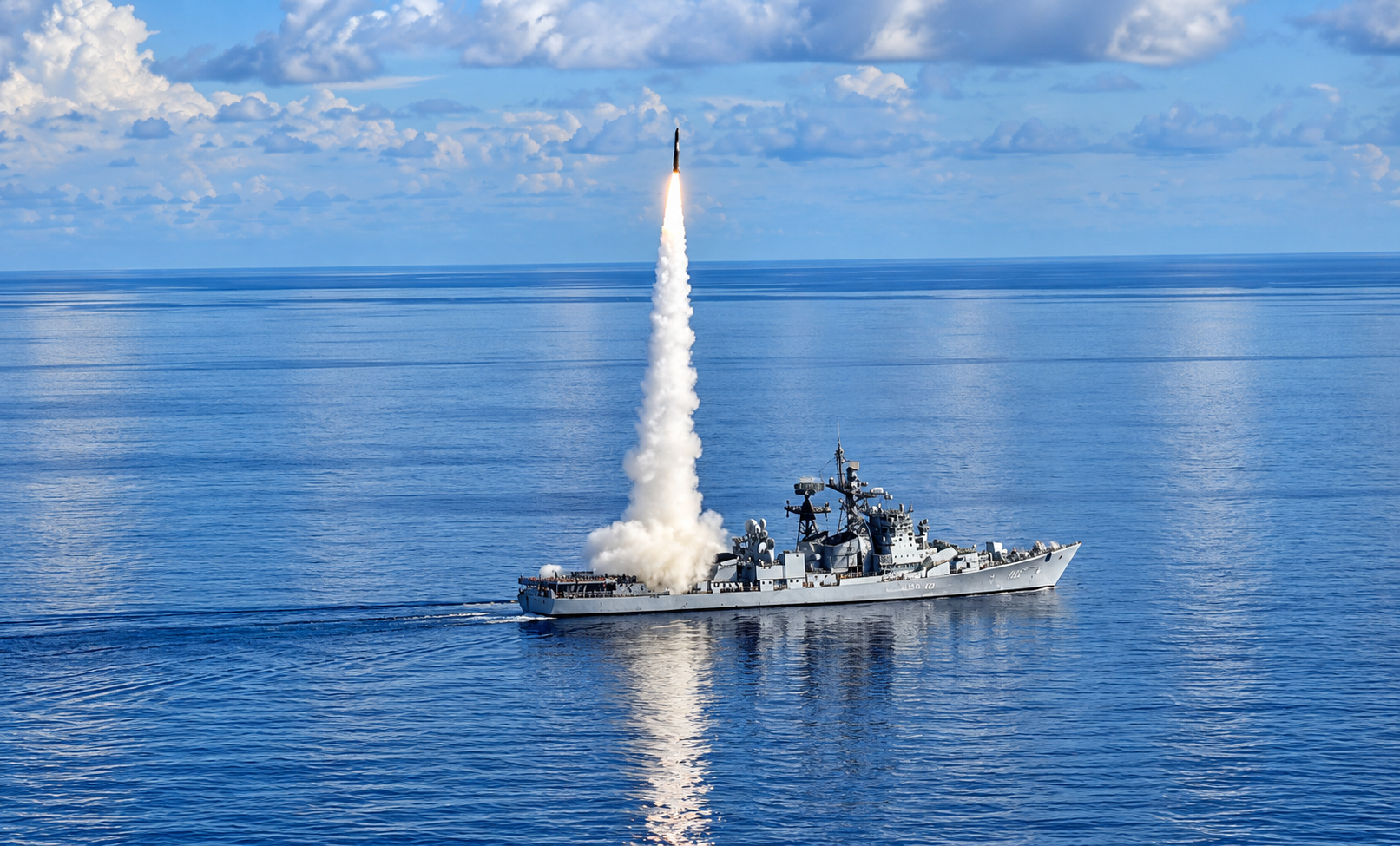
A file picture of BrahMos Cruise Missile
The Eastern Command sits astride India’s strategic maritime interests in the Bay of Bengal and the wider Indo-Pacific. Information about ships, submarines, logistics, command structures and sensitive installations is not merely tactical data.
In the wrong hands, seemingly unrelated fragments can be assembled into a larger intelligence picture of naval preparedness and operational capability.
Why Penetrate Indian Navy?
But there is a larger strategic question: what has prompted this apparent intensification of Pakistani efforts to penetrate India’s naval information architecture?
One possible answer lies in India’s rapidly expanding missile and maritime-strike capability, particularly the BrahMos supersonic cruise-missile programme.
BrahMos has increasingly become a defining component of India’s offensive deterrence and naval firepower. Deployed on Indian warships, the missile significantly enhances the Navy’s ability to project precision strike power at sea.
Its battlefield credentials were also highlighted during Operation Sindoor in 2025, when BrahMos featured in India’s military response and struck precise targets in Pakistan.
There is another dimension: BrahMos is no longer merely an Indian weapons programme. It is becoming an export story.
The Philippines has already acquired BrahMos systems under a deal reportedly worth $330 million, while Vietnam and Indonesia have emerged as prospective customers, with potential deals estimated at around $100 million and $200 million respectively, defence secretary R K Singh had stated.
That evolution changes the strategic equation.
For Pakistan, the concern may therefore extend beyond individual ships or installations. The intelligence hunt could be about understanding the architecture behind India’s emerging maritime strike capability—its platforms, deployment patterns, logistics, command structures and vulnerabilities.
Modern espionage rarely begins with an obvious breach of a classified vault. It can begin with a friend request, a WhatsApp message, a video call—or a seemingly harmless sexy photograph.
Hence, the weakest link may not always be a firewall. It may be the human being standing behind it.
About the Author

Prasanta Paul served Deccan Herald as the Chief of Bureau, Calcutta for nearly two decades before switching to work with various TV channels such as Al-Jazeera, CNN, German TV and CBS. He also headed the Eastern Bureau of Parliamentarian magazine. Mr. Paul who accompanied former Prime Minister Atal Behari Vajpayee on his overseas tour of Singapore and other Asian countries, travelled extensively to Bhutan, Sikkim and Darjeeling besides other Northeastern states. He briefly headed the Mizoram Bureau of the United News of India (UNI).
Discussion
Reader Comments
No comments yet. Be the first to share your perspective.