Bengal decides to cede ‘Chicken’s Neck’ to New Delhi
India to adopt a multi-layered defensive posture around the Siliguri corridor
19 May 2026, 07:19 pm IST·5 min read
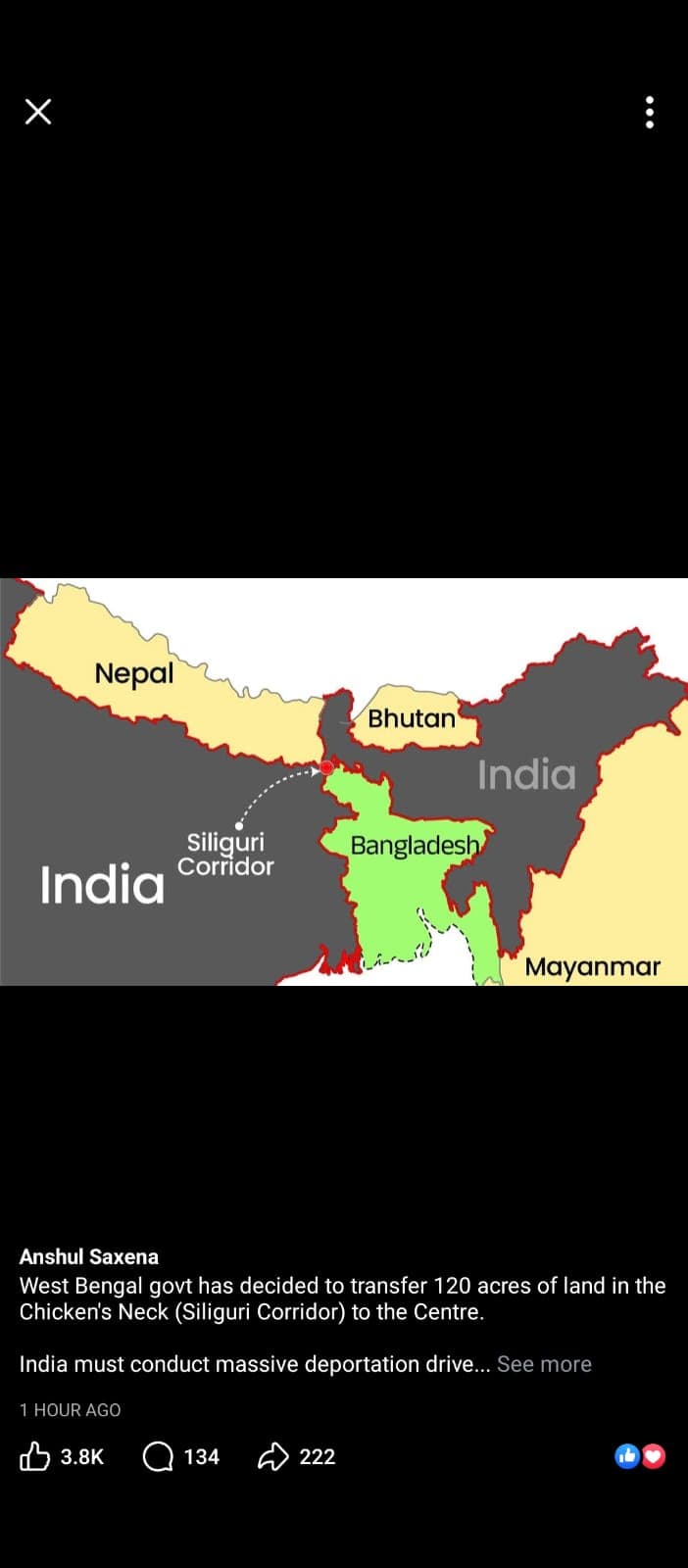
The BJP government that recently assumed office in West Bengal after a landslide verdict in April-May 2026 assembly elections, has decided to cede the crucial ‘Chicken’s neck’ in Siliguri in North Bengal to the federal government at New Delhi, official sources have confirmed.
The decision comes in the wake of India adopting a multi-layered defensive posture around the Siliguri corridor, including the deployment of advanced air defence systems such as the S-400 Triumph, the Indo-Israeli MRSAM system, and the Akash missile platform.
Three new military garrisons have been set up along the India-Bangladesh border — at Bamuni (near Dhubri, Assam), Kishenganj (Bihar), and Chopra (North Dinajpur, West Bengal) — giving a new dimension to security arrangements along the corridor.
Plus, troops under the Trishakti Corps (33 Corps) regularly conduct live-fire drills and mobility exercises. These initiatives come against the backdrop of Bangladesh's interim government's growing ties with China and Pakistan.
Critical Importance of Chicken’s Neck
The "Chicken's Neck" --- a 60-km long and 22-km wide strip of land in NorthBengal --- is one of the most strategically significant and geopolitically sensitive pieces of land in the world. It is essentially the thread on which India's territorial unity with the Northeast hangs. Its extreme narrowness, combined with hostile or unstable neighbours on all sides and China's military build-up nearby, makes it India's most critical and vulnerable geographic chokepoint — one that shapes military strategy, foreign policy, and regional economics all at once.
The name comes from its shape on a map — a thin neck connecting the "body" (mainland India) to the "head" (Northeast India). At its thinnest point, it is squeezed to only 20–22 km.
It is the sole terrestrial connection between India's mainland and its eight northeastern states, serving as a logistical lifeline for over 40 million people and crucial military movements.
The region is important for trade, commerce, and tourism for West Bengal, Sikkim, Assam, Nepal, Bhutan and Bangladesh. All land trade between the Northeast and the rest of the country passes through this corridor. The corridor is the hub of a rail and road network connecting West Bengal and the rest of India to the Northeast, including Assam, Nagaland and Sikkim.
Geopolitical Vulnerabilities
The corridor is surrounded by external states on three sides: Nepal lies to the west, Bhutan to the north, and Bangladesh to the south. To the northeast, just beyond Bhutan, lies China's Chumbi Valley, where Chinese military assets and infrastructure are positioned uncomfortably close.
Strategically, the Siliguri Corridor is the Achilles heel in the defence of almost 2,000 km of borders with China and Myanmar. With China continuing road and airstrip construction activities on its side of the border, the threat to the Chicken's Neck is a constant one, as the infrastructure could allow China to mobilise rapidly in the region.
The Doklam Connection
The Doklam Standoff (June–August 2017) highlighted the Siliguri Corridor's strategic vulnerability. The dispute was located at the Sikkim–Bhutan–Tibet trijunction. China began constructing a road on the Bhutanese-claimed territory; Indian troops intervened to stop it. A Chinese road through Doklam would have given Chinese forces a direct overlook of the Siliguri Corridor.
Bangladesh Dimension
According to the World Bank, both India and Bangladesh would benefit economically if they collaborated to "unstrangle" the Chicken's Neck by building transport corridors from mainland India to Northeast India through Bangladesh, which would create jobs and benefit neighbouring countries like Nepal and Bhutan, ensuring mutual economic growth.
However, it remains a flashpoint — Bangladesh's Rangpur Division's northern part, contiguous to India's Siliguri Corridor, is even narrower at 10–15 km at its most vulnerable section, making both sides mutually exposed in any potential conflict scenario.
Even as the new Tarique Rahman-led BNP government is yet to officially flex its muscles against New Delhi, there are often sporadically loud murmurs of protest against India’s decision of ‘push back’ of illegal infiltrators into Bangladesh and BSF’s firing on border smugglers.
Secondly, reports coming from across the border indicate that Bangladesh may, for the first time, join a strategic military alliance; and in all probability with Pakistan. For the fiscal year 2026-27, the Ministry of Defence has recommended an allocation of approximately $2.2 billion (Bangladesh Taka 27,000 crore) solely for the purchase of military equipment and advanced warfare technology.
Highway Corridors Transferred to Central Agencies
In view of the above, West Bengal chief minister Suvendu Adhikari has cleared the transfer of seven major highway corridors in North Bengal to central agencies, paving the way for the revival of several delayed road infrastructure projects across the state.
Among the roads being transferred, NHIDCL will handle the Hasimara-Jaigaon corridor near the Bhutan border, the Changrabandha border route, and the Siliguri-Darjeeling hill road — roads important not only for tourism but also for trade, military logistics and connectivity in the strategically sensitive Chicken’s Neck region.
In February 2026, the Federal government unveiled plans to construct underground railway tracks along the Siliguri Corridor. Union Railway Minister Ashwini Vaishnav announced this while outlining railway allocations in the Union Budget, highlighting special planning for the approximately 40-km strategic corridor in North Bengal.
The Northeast Frontier Railway confirmed the underground stretch would run between Tin Mile Haat and Rangapani railway stations, with a proposed ~22-km tunnel segment laid 20–24 metres below the ground level.
The decision to go underground is obviously driven primarily by security considerations in this part of the country.
Key Words: Assam-Bhutan-Bangladesh-BNP-BSF-China- Chicken’s Neck-Darjeeling- Doklam Standoff- India-NHIDCL- Pakistan - Siliguri-Sikkim- Tibet-West Bengal
About the Author

Prasanta Paul served Deccan Herald as the Chief of Bureau, Calcutta for nearly two decades before switching to work with various TV channels such as Al-Jazeera, CNN, German TV and CBS. He also headed the Eastern Bureau of Parliamentarian magazine. Mr. Paul who accompanied former Prime Minister Atal Behari Vajpayee on his overseas tour of Singapore and other Asian countries, travelled extensively to Bhutan, Sikkim and Darjeeling besides other Northeastern states. He briefly headed the Mizoram Bureau of the United News of India (UNI). To his credit goes a deep-rooted empathy for social issues and marginalized people. His extensive coverage on the Tsunami, the Super Cyclone in Odisha and the 2020 Amphan cyclone besides the Gaisal Train mishap in eastern India has easily been the best around the world.
Discussion
Reader Comments
No comments yet. Be the first to share your perspective.