BreakingNational
BJP’s Bengal victory to reshape Indo-Bangla Ties
The BJP’s Bengal win is just not a maiden political victory of the saffron brigade on the West Bengal soil.
18 May 2026, 11:08 am IST·5 min read
The BJP’s Bengal win is just not a maiden political victory of the saffron brigade on the West Bengal soil. It has ramifications that extend beyond the borders of the state.
The most crucial and important factor that is going to influence the geopolitical situation in this part of the country is India’s security posture towards Bangladesh and China, and a little distantly, Pakistan too.
Before I come to the issues of border fencing and the Teesta River water sharing which are mostly being talked about at present, the one that has either been quietly glossed over or escaped the glare of the local media was a major ISI-backed plan to sabotage India from the soil of Bangladesh.
The plan was nipped in the bud though, thanks to a timely combined strike by the Ajit Doval-led team and the new prime minister of Bangladesh Tarique Rahman of BNP.
ISI Game Plan
The blueprint of this ‘Kamikaze’ ambush to hit India hard began shortly after the last year’s unprecedented success of ‘Operation Sindoor’ that terribly shamed Pakistan before the world defense community following the latter’s abject failure to thwart Indian Air Force’s precision strikes on the terror modules and the prestigious Nur Khan airfield.
Nursing a grudge that looked near impossible to heal, the Shehbaz Shariff regime gave a ‘blank cheque’ to Pak army general Syed Asim Munir Ahmed Shah to ‘backstab’ India by any means possible.
The Md Yunus-led administration in Bangladesh which was in power then, came in handy as Yunus had by that time, concluded several defence agreements with Pakistan; and the bonhomie obviously paved the way for drawing a secret blueprint to sabotage India through the porus Indo-Bangladesh border that has remained unfenced over a large track in West Bengal.
The necessary recce by the Pak army officials had been done and the points of intrusion for launching a sudden terror attack were in place.
Everything was apparently going smooth till the lid was blown by a crack Indian secret service team that tipped the BNP supremo barely a couple of days before the subversive action was supposed to take place.
Pre-Dawn Raid
A special Bangladesh Commando Force launched a pre-dawn raid across several sensitive army establishments in Dhaka and surrounding areas and took into custody more than a dozen senior Bangladesh army officials for allegedly colluding with this sabotage plan. Some other army personnel involved in this racket however, managed to flee, reportedly to Turkey.
Interrogation of the detained army personnel and detail investigation thereafter revealed that the accused had secretly installed a high-capacity radar to monitor Indian army movements along the ‘Chicken’s Neck’ – the landlocked corridor in Siliguri in North Bengal connecting India with other eight northeastern states besides Bangladesh, Bhutan and Nepal.
Information thus collected was being fed to Inter-Services Intelligence (ISI) of Pakistan on a regular basis so that a sudden, coordinated ambush could allegedly be launched, officials said.
However, when the lid was effectively blown and the ISI-involvement came out in the open, Islamabad desperately pressed a panic button, shifting the blame on Tehrik-e-Taliban (TTK) of Afghanistan for organizing this subversive plan.
The TTK leadership headquartered in Pakhtun province of Afghanistan thousands of kms away from Dhaka, promptly denied this allegation, exposing the Pak handlers behind this gameplan.
This is one of the crucial reasons why union home minister Amit Shah stationed himself in West Bengal for more than a fortnight overseeing the electioneering of his party till the elections were over.
Strict Border Vigilance
Thus, the BJP victory in Bengal is being touted to be one of the watershed moments in the political history of the state as it is going to reshape the Indo-Bangladesh ties forever.
West Bengal is central to this tie because it shares a 2,216-kilometre border with Bangladesh, the longest stretch any Indian state shares with the neighbouring country. The border includes riverine areas, densely populated districts and routes that have long been associated with smuggling and illegal infiltration.
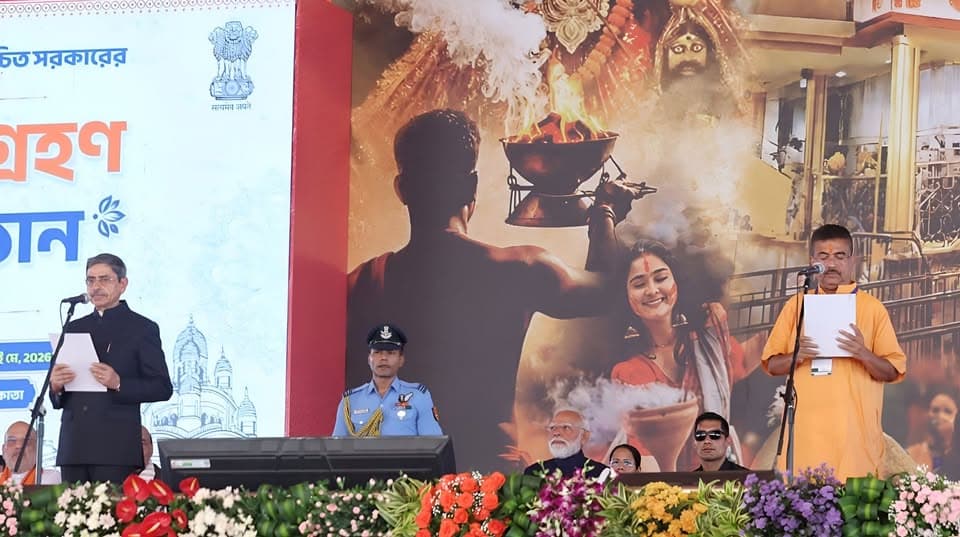
Hence, it is not for nothing that the newly elected chief minister Suvendu Adhikari announced handing over of the required government land to the Border Security Force on the maiden day of his assumption of office with a view to completing the incomplete job of border fencing.
For more than a decade, BJP leaders had accused the Mamata Banerjee-led government of adopting a soft approach towards illegal immigration and demographic changes in border districts which the TMC rejected. Notably, for close to 182 km of fence length, the TMC government had received payments from the Centre, but not handed over the land to the BSF.
The issue has assumed critical importance and additional sensitivity following the growing influence of Jamaat-e-Islami in some Bangladeshi border districts adjoining West Bengal. The last elections in Bangladesh saw the Islamist organisation perform strongly in regions such as Khulna, Rajshahi and Rangpur divisions, triggering apprehension of heightened move of radicalisation, smuggling networks and cross-border extremist activity.
Teesta Water Sharing Agreement
BNP Information Secretary Azizul Baree Helal had blamed Mamata Banerjee for blocking the earlier agreement and linked the BJP’s victory to hopes of progress.
“I think the Teesta Barrage project will be implemented under the (new)BJP government now that they have seized power instead of the Trinamool Congress," Helal was quoted as saying by ANI.
Appointment of Dinesh Trivedi as High Commissioner to Bangladesh
That India is keen to improve ties with its immediate neighbour in the eastern front has been demonstrated after the appointment of Mr Dinesh Trivedi as the new Indian High Commissioner to Bangladesh. India’s engagement with Bangladesh involves issues where West Bengal has a direct role, including border security, trade, migration and cultural ties. And Trivedi, with his prolonged stint in Bengal first in TMC and then in BJP since 2021, is likely to be a perfect fit.
About the Author
Prasanta Paul served Deccan Herald as the Chief of Bureau, Calcutta for nearly two decades before switching to work with various TV channels such as Al-Jazeera, CNN, German TV and CBS. He also headed the Eastern Bureau of Parliamentarian magazine. Mr. Paul who accompanied former Prime Minister Atal Behari Vajpayee on his overseas tour of Singapore and other Asian countries, travelled extensively to Bhutan, Sikkim and Darjeeling besides other Northeastern states. He briefly headed the Mizoram Bureau of the United News of India (UNI). To his credit goes a deep-rooted empathy for social issues and marginalized people. His extensive coverage on the Tsunami, the Super Cyclone in Odisha and the 2020 Amphan cyclone besides the Gaisal Train mishap in eastern India has easily been the best around the world.
Discussion
Reader Comments
No comments yet. Be the first to share your perspective.