BreakingCreative Corner
The Lake That Has Hidden a Thousand-Year-Old Secret
Roopkund puzzled science for the better part of a century.
01 Jul 2026, 02:43 pm IST·6 min read
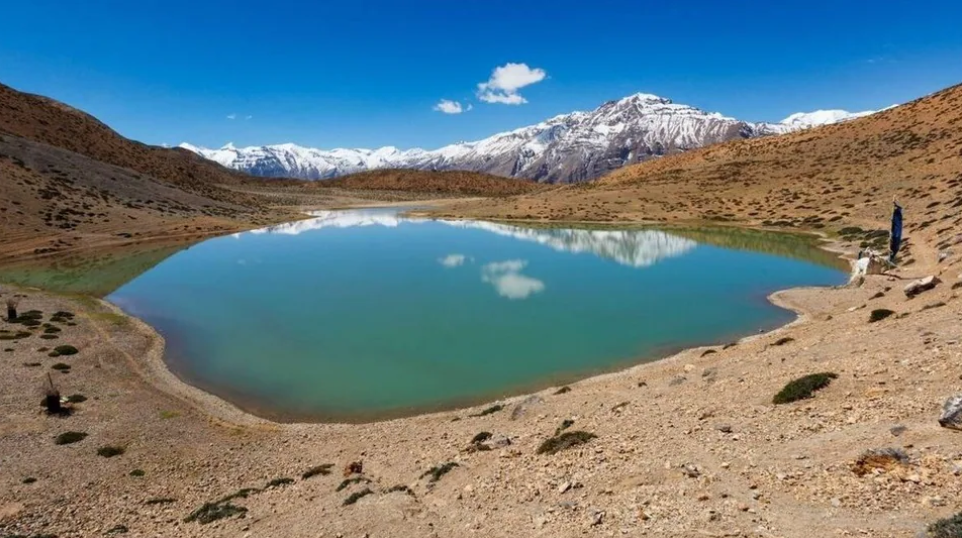
High in the Himalayas, at an altitude where the air thins and the silence feels almost physical, lies a small glacial lake that has puzzled science for the better part of a century.
Roopkund, in the northern Indian state of Uttarakhand, sits at 16,500 feet — a frozen bowl of water ringed by jagged peaks. For most of the year it is locked under ice.
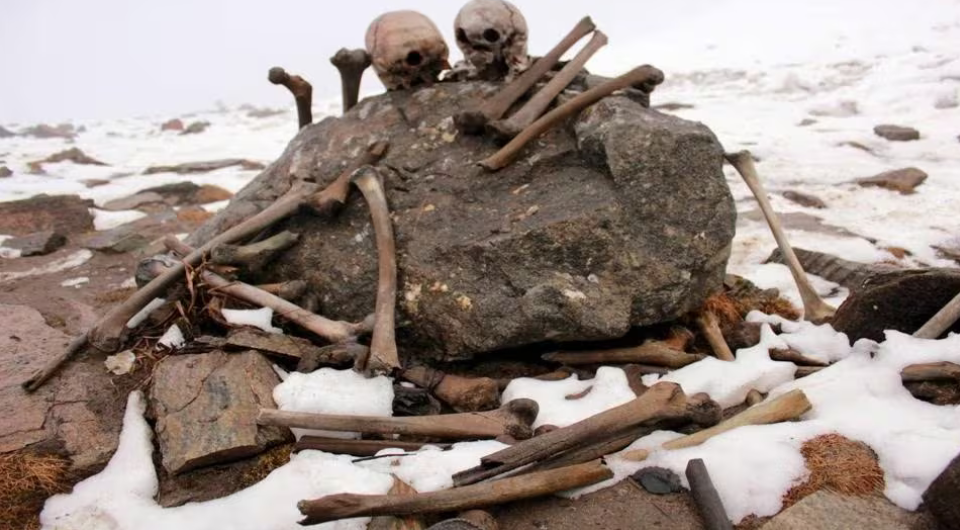
When the ice recedes each summer, it reveals something no other lake on Earth does: hundreds of human skeletons, some still clinging to scraps of leather and bamboo equipment, scattered across its banks and submerged in its shallows.
Local trekkers have known about the bones since at least the 1940s, when a British forest ranger stumbled on the site and, fearing a wartime atrocity, alerted authorities.
What he had actually found was older and stranger than any battlefield. For decades, the going theory was simple: a single catastrophic event, sometime around the ninth century, had killed a large group of people — pilgrims, soldiers, or a royal procession — all at once, perhaps in a sudden blizzard.
It was a tidy story. It was also, as it turns out, wrong.
A Question Written in DNA
In 2019, a team of geneticists, anthropologists, and archaeologists from institutions across India, the United States, and Germany published findings that dismantled the single-event theory altogether.
They extracted and sequenced the DNA from dozens of skeletons, then performed radiocarbon dating to establish not just who these people were, but when each of them died. In fact, the team analyzed the full genomes of 38 individuals.
What they found did not fit any existing narrative about Roopkund. Instead of a single homogenous group wiped out in one event, the skeletons split into three genetically distinct populations — separated not only by ancestry, but by centuries.
Three Genetically Distinct Populations
The largest cluster, 23 individuals, carried genetic ancestry consistent with people from present-day India and South Asia, though notably drawn from diverse regional subgroups rather than a single community. Radiocarbon dating placed their deaths between the 7th and 10th centuries CE — broadly consistent with the old folklore.
It was the second group that upended everything. Fourteen skeletons carried genetic ancestry, matching populations from the eastern Mediterranean — specifically resembling people from present-day Greece and Crete.
A final, single skeleton showed ancestry linked to East or Southeast Asian populations. Crucially, radiocarbon dating placed both the Mediterranean and East Asian remains not in the ninth century, but in the 19th — roughly two hundred years ago, more than a thousand years after the first group had died at the same spot.
Two Stories, One Lake
The implications are difficult to overstate. Roopkund was not the site of one disaster. It was the site of at least two, separated by over a millennium, involving populations from opposite ends of the Eurasian landmass who, as far as anyone can tell, had no connection with one another.
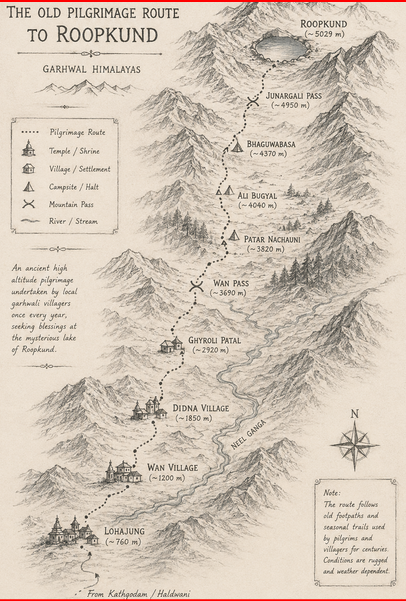
The South Asian deaths are at least loosely explainable. Roopkund lies along an old pilgrimage route associated with the Nanda Devi Raj Jat, a Hindu festival held once every twelve years that draws devotees on a gruelling Himalayan trek. A group of pilgrims caught in sudden, severe weather along this route is plausible, even if the exact circumstances remain undocumented.
The Mediterranean deaths are a far harder puzzle. There is no known historical record of a 19th-century group of Greek or Cretan travellers undertaking an expedition to this specific, remote stretch of the Himalayas.
Genetic ancestry is not the same as recent immigration, but the finding still raises uncomfortable questions for historians.
Were they part of a colonial-era expedition that left no surviving paperwork? Traders following some now-forgotten route? The researchers themselves were candid in their published findings: this part of the mystery remains unresolved.
What Killed Them
Skeletal analysis offers one consistent thread across the different groups: the manner of death looks similar, even if the timing and identity of the dead do not. Many of the skulls and shoulder bones show fracture patterns consistent with blunt-force trauma from above — round, heavy impacts rather than the kind of injuries associated with weapons or combat. There is no evidence of disease, starvation, or violence between individuals.
The leading explanation, reinforced by this more recent genetic work, is a sudden and unusually violent hailstorm.
Roopkund sits in a natural depression along an exposed ridge — precisely the kind of terrain where a fast-moving party caught without shelter would have nowhere to hide from large, fast-falling hailstones.
A Site That Keeps Changing Its Story
What makes Roopkund unusual isn't just the mystery — it's how thoroughly the application of modern genomic science overturned decades of confident assumption. For most of the 20th century, the bones were treated as a single archaeological puzzle with a single answer.
The 2019 study suggests something closer to a layered historical accident: a remote, harsh, but accessible high-altitude site that, across more than a thousand years, attracted different groups of travellers for different reasons, and occasionally killed them in the same brutal way.
As climate change accelerates glacial melt across the Himalayas, researchers expect more remains — and potentially more genetic surprises — to emerge from sites like Roopkund in the coming years. Each new skeleton is, in effect, a fresh roll of the dice: another data point that could confirm the current three-group picture, or complicate it further.
For now, Roopkund remains what it has been for nearly a century — a lake that draws trekkers and scientists alike, not despite its unanswered questions, but because of them.
Identical Sites Around the World
Roopkund is far from alone in forcing scientists to rewrite the stories bones tell. Europe's bog bodies — remarkably preserved corpses pulled from peat bogs in Denmark, Ireland, and the UK, such as Tollund Man and Lindow Man — once sparked similar speculation about ritual sacrifice or judicial execution. Isotopic and forensic analysis of these remains has since revealed surprisingly cosmopolitan diets and origins, hinting that Iron Age Northern Europe was far more interconnected than once assumed, much as Roopkund's DNA evidence overturned assumptions of a single homogeneous group.
A closer parallel comes from the mass graves of Jamestown and other early colonial sites in the Americas, where genetic and isotopic studies of skeletal remains revealed individuals of mixed African, European, and Indigenous ancestry buried together.
Similarly, the Wari Empire's elite tombs in Peru and the sacrificial sites atop Andean peaks (the famous "Inca ice mummies," including the children of Llullaillaco) have undergone DNA and isotope analysis that exposed long-distance journeys and surprising genetic diversity among victims once assumed to be local nobility.
Perhaps the most thematically resonant comparison, though, is the mass grave at Sandby Borg in Sweden, a fifth-century massacre site where genetic analysis revealed unexpected kinship patterns among the dead, and the Towton battlefield remains in England, where soldiers from a 1461 battle showed surprisingly diverse regional and even continental origins.
What unites all these discoveries — Roopkund included — is a single recurring lesson: ancient remains routinely defy the neat, single-narrative explanations local legend assigns them.
Modern genomics keeps revealing that human mobility, trade, and migration in the pre-modern world were far more extensive and tangled than written history alone ever suggested.
About the Author

Prasanta Paul served Deccan Herald as the Chief of Bureau, Calcutta for nearly two decades before switching to work with various TV channels such as Al-Jazeera, CNN, German TV and CBS. He also headed the Eastern Bureau of Parliamentarian magazine. Mr. Paul who accompanied former Prime Minister Atal Behari Vajpayee on his overseas tour of Singapore and other Asian countries, travelled extensively to Bhutan, Sikkim and Darjeeling besides other Northeastern states. He briefly headed the Mizoram Bureau of the United News of India (UNI).
Discussion
Reader Comments
No comments yet. Be the first to share your perspective.