BreakingNational
War of The Wall: When A University Turns Into A Political Battlefield
A curious cat-and-mouse game unfolding at Jadavpur
04 Sep 2026, 11:17 am IST·4 min read
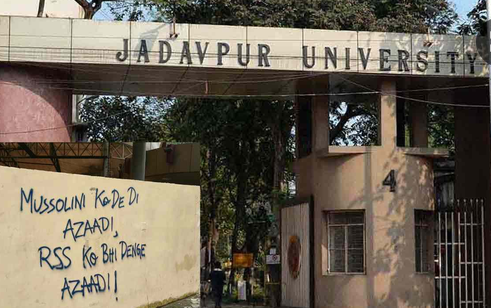
A curious cat-and-mouse game is unfolding at one of India’s most celebrated academic institutions—Jadavpur University in Kolkata.
It is a spectacle that would have appeared almost unimaginable in an institution once renowned for its rare combination of intellectual brilliance, scientific innovation and academic excellence.
Yet today, the battle over its walls has become symbolic of a much larger confrontation—between a minuscule section of politically mobilised students determined to reclaim the campus as a space for ideological assertion and an administration, backed by the state government, seeking to restore what it describes as academic discipline and institutional order.
The immediate flashpoint is graffiti.
Following Chief Minister Suvendu Adhikari’s objection to what he described as “anti-national” and inflammatory slogans on the university walls, the authorities moved to erase a large number of graffiti with white paint.
Among the slogans that had triggered controversy were references to Maoist leader Kishenji, calls associated with “Kashmir ki Azadi”, and one particularly provocative message that reportedly said: “Fascists have no right to democracy; they should be shot in the head.”
Why the walls of the Arts Faculty should carry slogans such as “Kishenji Red Salute” and why cries of “Kashmir Maange Azadi” should emanate from the campus, the chief minister questioned.
Vice-Chancellor Chiranjib Bhattacharya who appealed to all to keep the campus clean, made it clear that he was not opposed to freedom of expression—but neither was he in favour of turning university walls into permanent political billboards.
Whitewashing the Walls?
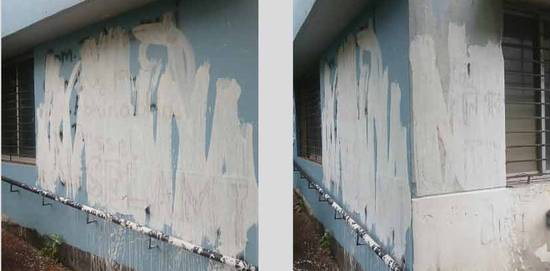
His argument was practical as well as institutional: Jadavpur University does not possess the infrastructure to repeatedly erase graffiti, and therefore the municipal authorities stepped in to undertake the task.
But the whitewashing proved short-lived.
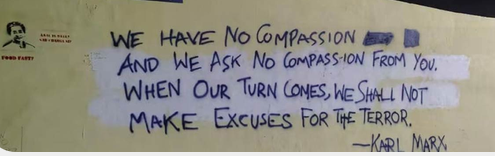
Within barely 24 hours, slogans returned to the walls. One of them carried a quotation attributed to Karl Marx declaring that when the time came, revolutionary forces would not hesitate to use revolutionary power.
Next night, municipal workers again entered the campus and erased the fresh graffiti.
That, however, triggered another controversy.
The Revolutionary Students’ Front (RSF) alleged that police personnel accompanied the municipal workers and questioned how the police entered the campus late at night.
Vice-Chancellor Bhattacharya maintained that while he knew the municipality would undertake the cleaning operation, he had not been informed that police personnel would accompany the workers.
The controversy has now become a battle over autonomy, political symbolism and control of public space within a university.
Threat to Reclaim the Walls
Left-wing student organisations have openly indicated that they would seek to “take back” the walls. The SFI has announced a programme called “Take Back Your Walls”, signalling that the erased slogans may be replaced yet again.
And therein lies the real problem.
The issue is not whether students have the right to hold political opinions. Universities have historically been spaces of debate, dissent and ideological contestation. Nor can a university become an intellectually sterile zone where inconvenient questions are prohibited.
But there is an equally important distinction between freedom of expression and the systematic occupation of an academic institution by a politically aggressive minority.
A university belongs not merely to the loudest ideological group on campus. It belongs to every student, teacher, researcher and employee. The walls, corridors and classrooms of a premier academic institution cannot permanently become battlegrounds for competing political armies.
The deeper tragedy is that Jadavpur University—an institution capable of producing pioneering scientists, scholars, engineers, artists and thinkers—is increasingly being discussed not for academic breakthroughs but for campus clashes, confrontational slogans and political street fights.
Fresh Graffiti Debate
The controversy has also opened another debate over the cultural identity of the institution. Jadavpur MLA Sharbari Mukhopadhyay has questioned why the walls cannot instead display the constitutional illustrations of Nandalal Bose or the thoughts of Sri Aurobindo.
She has even suggested that the university should be renamed after Sri Aurobindo, the seer who founded this university.
Whether that proposal gains acceptance is another matter. But it underlines the growing struggle over what Jadavpur University should represent.
For the moment, its walls have become the metaphor for that struggle.
Every slogan erased is followed by another being written. Every attempt to restore institutional neutrality is portrayed as political suppression. And every act of ideological defiance invites a stronger administrative response.
That is the cat-and-mouse game consuming Jadavpur University.
Unless sanity prevails, the danger is that a small but determined section may continue to hold one of India’s premier universities hostage to an endless cycle of provocation and retaliation.
Obviously, the far more important business of a university, the pursuit of knowledge, quietly gets pushed to the background.
About the Author
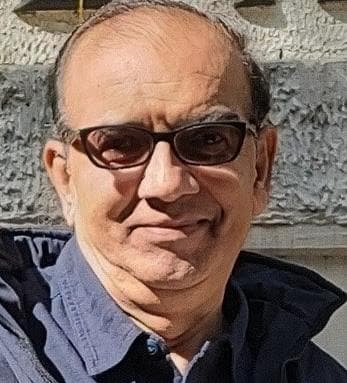
Prasanta Paul served Deccan Herald as the Chief of Bureau, Calcutta for nearly two decades before switching to work with various TV channels such as Al-Jazeera, CNN, German TV and CBS. He also headed the Eastern Bureau of Parliamentarian magazine. Mr. Paul who accompanied former Prime Minister Atal Behari Vajpayee on his overseas tour of Singapore and other Asian countries, travelled extensively to Bhutan, Sikkim and Darjeeling besides other Northeastern states. He briefly headed the Mizoram Bureau of the United News of India (UNI).
Discussion
Reader Comments
No comments yet. Be the first to share your perspective.
Similar Stories

National
Could the Bay of Bengal Hold a New Oil Bonanza for Bengal?
Future oil discoveries in the Bay of Bengal could be substantially larger than those currently being produced at Ashoknagar, Samik Bhattacharya.
Prasanta Paul·21 Sep 2026
National
Diamond May Soon Start Shining in Bengal, Samik Bhattacharya
“We’ve to reverse-engineer the earlier flight of capital from Bengal,” said Samik Bhattacharya “from diamonds to chips, capital has to return”.
Prasanta Paul·19 Sep 2026

National
Fair Is Foul, Foul Is Fair
Central Drugs Control issues a public-health alert against two unauthorised Pakistan-made cosmetic products—Goree Beauty & Chandni Whitening Cream.
Prasanta Paul·17 Sep 2026
